What Iliac Crest Pain Feels Like When You Run
Iliac crest pain running has gotten complicated with all the conflicting advice flying around. Ice it. Don’t ice it. Stop running. Never stop running. So let me just tell you what it actually feels like first — because if you’ve got it, you’ll recognize it immediately.
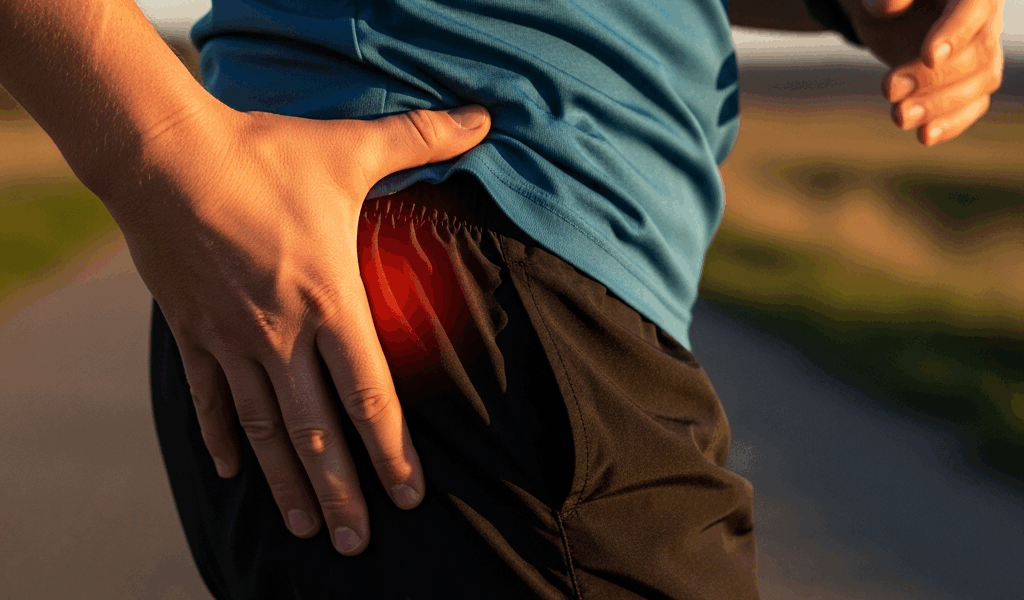
You’re cruising through mile three of what should be an easy ten-miler when it hits. A sharp, localized sting right at the top of your hip bone — exactly where your hand rests when you stand with your arms at your sides. Not a dull ache. Not general muscle soreness. Something more specific than that, almost insultingly precise in its location.
The sensation intensifies as the run progresses. Hills make it worse. Fatigue makes it worse. By the final miles, when your form starts falling apart, it’s genuinely hard to ignore. That’s what separates iliac crest pain from other hip injuries — the location is unmistakable. The iliac crest is the bony ridge running along the top of your pelvis. Feel it right now. Put your hands on your hips. That ridge. The pain lives there, on that bone or just below it, sometimes radiating down into the glute or lower back — but the epicenter never moves.
The first time around, I assumed it was IT band syndrome because the pain seemed to travel toward my knee. Spent three weeks foam rolling my outer thigh before my coach finally said — “just point to where it hurts.” The moment I pointed directly at that bony ridge, the whole recovery approach changed.
Here’s a useful diagnostic detail: the pain isn’t constant at rest. You can walk normally, sit comfortably, sleep fine. But trigger it on a run? It lights up fast. Most runners describe it as worst in the second half of long runs, or reliably aggravated on hilly routes where your hip extensors are working overtime. Some athletes report discomfort lying on that side at night — though honestly, that’s not universal. The sharpness of it makes runners nervous about severity. Most cases, though, respond well within four to six weeks if you treat the right thing.
The Three Most Common Causes for Runners
Understanding why your iliac crest hurts matters more than just chasing the symptom. Runners have specific biomechanical patterns that create this injury, and identifying your particular cause determines which fixes actually work.
Muscle Attachment Inflammation
But what is the iliac crest, really? In essence, it’s a bony ridge at the top of your pelvis. But it’s much more than that — it’s essentially a muscle attachment hub. Your gluteus medius, gluteus maximus, and external obliques all anchor to or near this ridge. When you run fatigued, or with poor form, or after suddenly spiking your volume, those attachment points get overloaded. The inflammation happens right at the insertion — where muscle meets bone.
This is the most common cause in runners training for marathons or triathlons. Picture it: eight weeks of sensible mileage building, and then — one ambitious week — a tempo run plus a track workout crammed together. The glutes, already running on empty, can’t stabilize the pelvis properly. They pull harder at their attachment points to compensate. Inflammation follows, predictably, painfully.
The pain concentrates directly on the bony crest. Sharp. Reproducible. Same pain, same spot, every time you hit that mileage threshold.
IT Band Tension Creating Traction on the Crest
Your iliotibial band travels right past the iliac crest as it runs down the lateral thigh. Runners with chronically tight hip flexors and TFL — tensor fasciae latae, the muscle just below your hip bone — develop compensatory tightness throughout this whole region. That tension pulls on the iliac crest, creating inflammation where the IT band connects to or passes over the ridge.
This one’s more common in runners who sit at a desk for eight hours daily, then expect their hips to perform. Your hip flexors are basically concrete blocks by 5pm. Something has to give — and it’s usually that attachment point.
The distinguishing feature here: pain is worst after sitting for a long stretch before a run, eases slightly as you warm up, then creeps back in the second half. Cyclical rather than consistently sharp. That pattern matters when you’re trying to figure out what’s actually going on.
Weak Hip Stabilizers Causing Abnormal Pelvic Loading
Probably should have opened with this section, honestly — because this is the root cause underlying maybe sixty percent of iliac crest pain cases I’ve seen. When your gluteus medius is weak — and it’s weak in most runners who don’t specifically train hip stability — your pelvis shifts side to side with each stride. Trendelenburg gait, clinically speaking. Recognizable if you know what to look for.
Weak lateral hip stabilizers force your glute maximus to work overtime providing stability it was never designed to provide alone. That extra pulling at the attachment point on the iliac crest creates inflammation. The abnormal pelvic mechanics create uneven loading — and whichever side is compensating harder is the side that eventually breaks down.
Don’t make my mistake. During my second encounter with this injury, I spent an entire training season doing zero dedicated hip strength work. Just running — nothing else. My gluteus medius strength had probably dropped twenty percent. That was enough. The pain came back, gradually building week by week rather than arriving suddenly. That slow, progressive pattern screams weak stabilizers.
Immediate Relief — What to Do Today
You don’t need to stop running entirely — but you do need to be smart right now.
Ice the area fifteen minutes, three times daily. I know, ice feels like advice from 1987. But inflammation at a bone attachment genuinely responds to it. A standard gel ice pack — the blue ones, $4-6 at any pharmacy — wrapped in a thin towel does the job. Direct ice on skin causes ice burn. The thin barrier prevents that.
Over-the-counter NSAIDs help during the acute phase. Ibuprofen 400mg twice daily for one week can reduce inflammation enough to allow training to continue without significant pain. Don’t use them long-term — they mask symptoms while you’re training, which can quietly worsen the underlying problem. Strategically, though, they’re useful right now while you implement the actual fixes.
Reduce mileage by twenty to thirty percent for the next two weeks. Not complete rest — this is important. Most runners with iliac crest pain can still run. Cut the long run down. Skip the speed work. Stick to easy-pace runs three to four times weekly. Running through severe pain just extends the whole timeline, which nobody wants.
Foam rolling your hip flexors and TFL matters more for this injury than most people realize. Two minutes daily on each side. A standard foam roller runs $20-35. Position it under your hip flexor — the front of your hip, just below the hip bone — and roll slowly up and down. Tender, but not unbearable. This directly addresses one of the three main causes without any special equipment.
Stretching deserves specific mention because generic hip stretches genuinely don’t cut it here.
- 90/90 hip stretch: Sit on the floor with one leg bent at ninety degrees in front of you, the other bent at ninety degrees to the side. Chest upright, lean forward slightly over the front leg. Hold 45 seconds. Twice daily, each side. Targets glutes and external rotators.
- World’s greatest stretch: Start in a push-up position. Step your right foot to the outside of your right hand, rotate your torso right, reach your right arm toward the ceiling. Hold five seconds, return to push-up position. Ten reps per side. Mobilizes hips and thoracic spine — apparently named that for a reason.
- Half-kneeling hip flexor stretch: Right knee down, left leg forward. Push hips forward until you feel the stretch in the front of your right hip. Hold 45 seconds, twice per side. This one directly addresses tight hip flexors — a main driver for many runners.
Strengthening Exercises That Fix the Root Cause
Probably should have opened with this section, honestly. You can ice and stretch indefinitely, but without strengthening the weak stabilizers that created this injury, it returns the moment training ramps back up. That’s the cycle most runners get stuck in.
Three strengthening sessions weekly for four to six weeks. None of these are complicated. While you won’t need a full gym setup, you will need a handful of things — mostly just a resistance band, which runs $8-12 for a decent set.
Clamshells
Lie on your left side, knees bent, feet together. Keep feet touching while you open your right knee upward — like a clamshell. Pause two seconds at the top. Three sets of fifteen reps per side. You should feel this in your gluteus medius, not your lower back. If you feel it in your lower back, your range of motion is too big.
This directly targets the lateral hip stabilizer that’s almost certainly weak if you’re dealing with iliac crest pain.
Side-Lying Hip Abduction
Lie on your left side, both legs straight. Lift your right leg upward about two feet — keeping your hips stacked vertically, not rolling backward. Lower without letting your legs touch. Three sets of fifteen reps per side. Harder than clamshells. Really hammers the gluteus medius and minimus, which might be the best starting point if clamshells feel too easy, as this injury requires genuine lateral hip strength. That is because the pelvis needs something to anchor it during each stride.
Single-Leg Deadlifts
Stand on your left leg, slight knee bend. Hinge at your hips and extend your right leg behind you for counterbalance, lowering your torso until it’s roughly parallel to the ground. Left leg is your only contact point. Return to standing. Three sets of ten reps per side — at least if you can maintain form throughout. If you’re wobbling badly on rep three, that’s useful information about where your stability actually is.
Single-leg deadlifts demand stability from your entire hip girdle. Harder than they look. Effective in a way that’s almost annoying.
Bird Dogs
Start on hands and knees. Extend your right arm forward and left leg backward simultaneously until both are in line with your torso. Pause two seconds. Return, alternate sides. Three sets of twelve reps per side. Targets glute maximus activation and core stability — both necessary for controlling what your hips do during running.
First, you should start these exercises at the level where perfect form holds for every single rep — at least if you actually want to recover rather than just feel like you’re doing something. Progress slowly. Add reps before adding difficulty.
When to See a Doctor vs Self-Treat
Most iliac crest pain responds to the protocol above within four to six weeks. Certain warning signs, though, mean you need medical evaluation sooner rather than later.
See a doctor if:
- Pain is present at rest — not just during running
- Pain worsens over two weeks despite reduced mileage
- You experience numbness or tingling anywhere in your leg
- Visible swelling appears at the iliac crest itself
- Pain comes with fever or other unexplained systemic symptoms
These signs could indicate stress fracture — possible in high-mileage runners, rare overall. Probably less than five percent of all iliac crest pain cases, if the data I’ve seen is accurate. But stress fractures demand completely different treatment than muscle attachment inflammation, so getting it wrong is costly.
High-mileage runners training for marathons or ironmans with sudden iliac crest pain should be particularly cautious. Stress fractures develop when bone is repeatedly loaded beyond its capacity to adapt — and if you’ve recently jumped weekly mileage by more than ten percent, or added unusual volume in a short window, your risk is meaningfully higher.
An X-ray is the standard starting point. An MRI is more sensitive — and more expensive. Most confirmed stress fractures require four to eight weeks away from running.
If it’s muscle attachment inflammation or IT band tension — which is what you almost certainly have — you can resolve this yourself. Trust the strengthening work. Be patient with the timeline. Run easy while recovering. Most runners are back to normal training within five to seven weeks, which feels long in the middle of it and completely reasonable in hindsight.



Stay in the loop
Get the latest triathlete today updates delivered to your inbox.