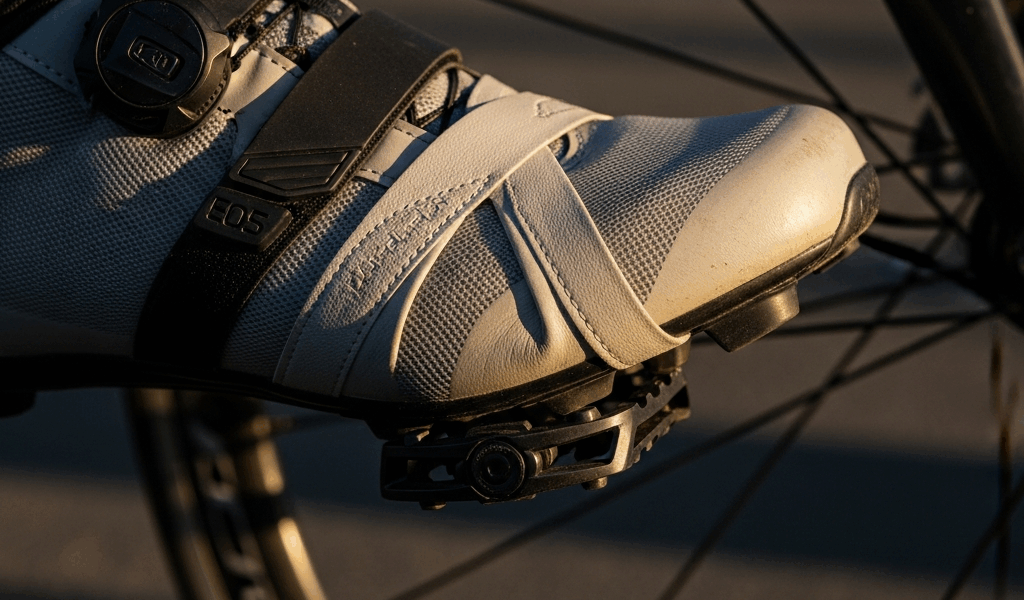
Why Your Toes Go Numb on the Bike
Toe numbness in triathlon has gotten complicated with all the conflicting advice flying around. Loosen your shoes. Tighten your shoes. Move your cleats. Buy new shoes. Everyone has a theory, and most of them are right — for somebody. Just not necessarily for you.
There are three distinct mechanisms at work here. First: nerve compression — your shoe pressing directly on the digital nerves running along the bottom of your foot, mostly in the forefoot near the metatarsal heads. Second: blood flow restriction, caused by tight lacing, foot swelling from heat or prolonged effort, or both compressing the arteries feeding your toes. Third: cleat position. Cleats sitting too far forward force your forefoot to absorb load it was never designed to carry for three hours straight.
Most articles just say “loosen your shoes” and move on. That works if lacing is your problem. It doesn’t if your cleats are positioned like you’re trying to tap-dance on a pedal. The fix depends entirely on which cause applies to you.
How to Figure Out Which Problem You Have
Probably should have opened with this section, honestly. I spent two full seasons tightening and repositioning my cleats obsessively before realizing I was just shuffling the problem around instead of actually diagnosing it.
Start with timing. Does numbness hit around mile 5, or does it creep in after about 90 minutes? Early onset almost always points to shoe fit or cleat position — a structural problem present from the moment you clip in. Late onset usually means foot swelling, especially on hot race days when your feet have had time to expand inside a rigid carbon sole.
Next, location. All toes, or just the outer two? Just the big toe? One-sided numbness — say, the right foot only while the left stays fine — suggests cleat drift, float issues, or something asymmetrical going on structurally. Global numbness across all toes points toward overall forefoot pressure or systemic swelling.
Then run through your shoe behavior. Does it get worse when you cinch the laces tighter for stability? Worse in aero position when your foot angle changes? Worse on hot race days when you’ve already swum and transitioned before the bike even starts? Worse in your tri shoes specifically but not on your road bike? These details matter more than most people realize. Write them down if you have to.
Cleat Position Fixes That Actually Stop It
Here’s what changed everything for me: moving my cleats backward.
Your cleats mount on a rail under the ball of your foot. Factory standard on most tri shoes places them right at the metatarsal heads. Move them rearward toward the arch — 5 to 8 mm is the range most fitters recommend — and you shift pressure away from those forefoot nerves. The improvement, when cleat position is your actual problem, is immediate.
But what is the real issue here? In essence, it’s load distribution. But it’s much more than that. Tri shoes have carbon-reinforced soles that are stiffer than most road shoes — great for power transfer on steady climbs, genuinely terrible for the soft tissue under your toes during hour two when every millimeter of pressure starts to feel like a thumbtack.
That’s what makes midfoot cleat placement endearing to us long-course athletes. Moving cleats backward spreads load across a wider structure and drops peak pressure in the sensitive forefoot zone. So, without further ado, here’s how to actually do it.
Unbolt your cleats entirely — most tri shoes use standard three-bolt Shimano SPD-SL mounting. Mark the original position with a fine-tip pen or a piece of tape. Move the cleats 5 mm back. Measure it with a ruler; don’t eyeball it. Ride for a week. If numbness improves, try another 3 mm back. If power transfer suffers noticeably, bring them forward 2 mm. Small increments.
Lateral cleat position is worth checking too. Some people develop one-sided numbness because a cleat has gradually drifted inward or outward, creating uneven pressure across the foot. If your left foot goes numb and your right doesn’t, check whether the left cleat has migrated away from the shoe centerline. Realigning it parallel takes about four minutes and occasionally solves the whole problem.
Float and rotational freedom are the last piece. Standard SPD-SL yellow cleats come with 6 degrees of float. Some athletes with stubborn one-sided numbness see real improvement after switching to red 9-degree float cleats — around $40 for a set from any decent bike shop — which allow the foot to follow its natural rotation path and relieve lateral nerve compression. Don’t make my mistake of dismissing this as marginal. I wasted a full season thinking it was.
Shoe Fit and Lacing Adjustments to Try First
Before touching any hardware, check the simple variables.
Toe box width is foundational. Tri shoes run narrow — lighter fabric, lower drag, all that. A shoe that fits perfectly in a cool shop at sea level can feel like a compression device two hours into a hot race after your foot has swollen. I’m apparently a true 42.5 and Shimano RC7 works for me while Specialized S-Works never quite did. I sized up to a 43 in the Shimano and eliminated most of the forefoot pressure in one move. It seems like overkill. It isn’t. Experienced ultramarathoners routinely size up for hundred-milers. Long-course triathletes should think the same way.
Lacing pressure matters because different closure systems distribute pressure differently. BOA dial systems — like the dual-dial setup on Shimano’s RC902 — apply even radial pressure across the midfoot. Velcro straps create hotspots when tightened unevenly, which happens constantly in T1 when you’re rushing. Traditional laces require active management. Too tight across the forefoot is the single most common mistake.
The fix: lace loosely from toe to midfoot, moderately firm from midfoot to heel, snug only at the heel itself. Your forefoot needs mobility, not containment. You should be able to fit one finger under a tight lace at the ball of the foot — at least if you want blood flowing to your toes past hour one. If you can’t, you’re already restricting circulation before the race starts.
On hot days, add one more variable. Try a thinner aftermarket insole. Brands like Superfeet Blue ($45 at most running shops) or Powerstep Pinnacle ($35 online) replace the factory insole with something slightly lower-profile. A quarter inch less insole height reduces forefoot compression meaningfully. It sounds marginal. It’s not.
When Numbness Is a Nerve Issue, Not a Fit Issue
But what is Morton’s neuroma? In essence, it’s a thickening of tissue around the nerve between the third and fourth toes. But it’s much more than a fit problem — it’s a structural one, and it behaves differently from mechanical pressure numbness.
Frustrated by what felt like a persistent pebble stuck under her foot, a training partner of mine spent two seasons adjusting cleats and swapping insoles before a podiatrist confirmed Morton’s neuroma using a standard ultrasound at her first appointment. That was 2021. The cleat adjustments hadn’t helped because they were never going to help.
The distinguishing signs: sharp, localized burning pain rather than spreading dull numbness, a sensation like something is physically lodged under the ball of your foot, and — critically — numbness or discomfort that persists even when the shoe is off and your foot is elevated. Mechanical pressure numbness resolves quickly once you’re off the bike. Neuroma pain doesn’t.
A sports podiatrist can confirm diagnosis with imaging and recommend proper treatment. While you won’t need surgery in most cases, you will need a handful of specific interventions — metatarsal pads, cortisone, sometimes orthotics — that no amount of cleat adjustment will replace. Distinguish between them before spending four months moving hardware around.
Toes going numb on the bike is fixable. Most of the time it doesn’t require a doctor, an expensive bike fit, or new shoes. It requires honesty about which problem you actually have — and enough patience to change one variable at a time until you find it.

Stay in the loop
Get the latest triathlete today updates delivered to your inbox.