Aero Position Fights Your Lungs
Triathlon breathing has gotten complicated with all the conflicting advice flying around. But here’s the blunt truth: you breathe wrong on the tri bike because your position makes breathing right nearly impossible.
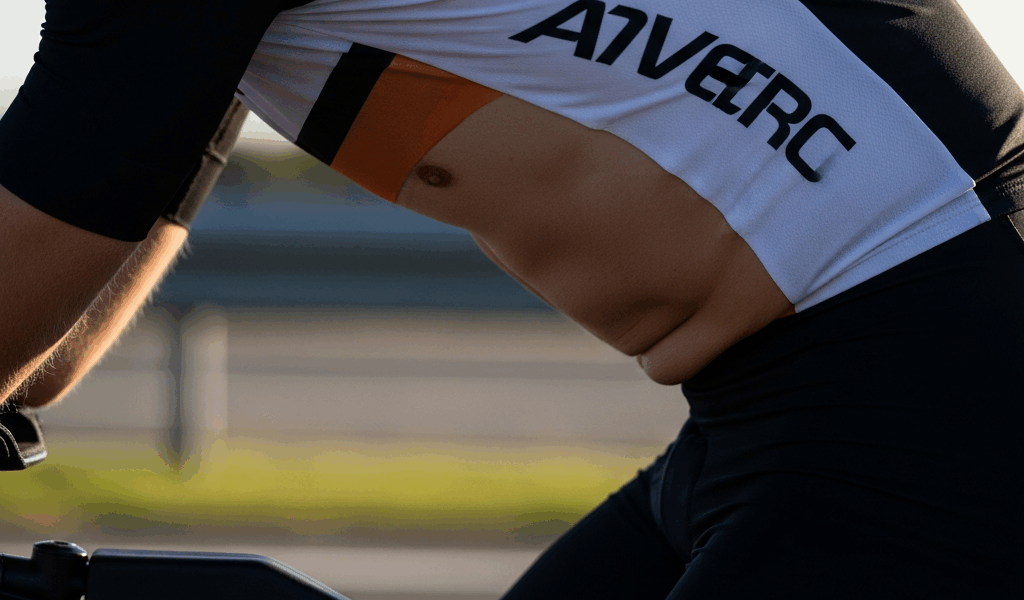
Drop into aero and your torso folds forward. Ribs angle down. Belly presses against thighs. Great for drag — that’s the whole point — but it crushes your diaphragm, the muscle doing roughly 80% of your breathing work. Tucked like that, your body abandons its primary breathing mechanism almost entirely. Chest and shoulders take over. Secondary muscles. They fatigue fast when you lean on them for two-plus hours.
The cost is real and measurable. Chest breathing is shallow — pulling air into only the upper lung lobes while the lower lobes sit mostly idle. Your body notices the inefficiency immediately. Sympathetic nervous system fires harder. Heart rate climbs. Perceived effort spikes. You feel completely gassed even though your aerobic engine could handle the wattage. Your breathing mechanics just won’t cooperate.
I learned this the hard way at a 70.3 in 2019. Mile eight of the bike, I was gasping like I’d been sprinting, but my power file showed a comfortable Z2 effort — maybe 210 watts. My coach pulled video and gave me three words: “Your shoulders are shrugging.” He wasn’t wrong. Every single inhale hiked my shoulders toward my ears. After two hours of that, my traps were completely destroyed and my tank felt empty when it genuinely wasn’t.
The aero compression isn’t your enemy. The broken breathing pattern is.
How to Tell If This Is Happening to You
Probably should have opened with this section, honestly. Before fixing anything, you need to catch it happening. Here’s what shallow chest breathing actually feels like mid-ride:
- Shoulders rise noticeably with each breath. Film yourself or have a training partner record a few minutes of footage. Shoulders hiking an inch per inhale? That’s chest breathing. Full stop.
- Heart rate runs 5–10 bpm higher than your power warrants. Holding 280 watts but sitting at 155 bpm when you’d expect 145? Your fitness is fine. Your breathing economy isn’t.
- You feel air-hungry at moderate effort. Not because you’re redlining. Just because the air doesn’t feel like it’s actually landing anywhere useful. There’s a vague, low-grade panic to it — even when pace is totally manageable.
- Neck and upper trap tension builds steadily through the ride. By mile 15, your neck is aching. Shoulders feel locked up. That’s what happens when you spend hours stabilizing a shallow breathing pattern with muscles that were never meant for the job.
If three or four of those sound familiar, your position and your breathing are actively fighting each other. Good news: this is fixable in about two weeks.
The Fix Starts With Your Belly, Not Your Chest
But what is diaphragmatic breathing, exactly? In essence, it’s using your diaphragm — the dome-shaped muscle sitting just below your lungs — as the engine of each breath rather than your chest. But it’s much more than that. It’s a full reprogramming of a pattern your body has likely defaulted away from every time you tuck into aero.
Start off the bike entirely. Couch, chair, floor — doesn’t matter. One hand on your chest, one on your belly. Breathe in through your nose for a slow count of four. Your belly hand should push outward. Your chest hand stays mostly still. That’s the target pattern. Do this for five minutes a day, three days running, before you ever take it to the trainer.
Once it feels almost automatic sitting upright, move to the trainer. Full aero tuck — same position as race day, same fit. Same drill. Hand on belly. Four-count inhale through the nose. Here’s the cue that actually works: feel your belly press against your thighs as you expand. Not forcefully. Just notice the contact. That pressure against your legs is confirmation the diaphragm is doing the work — not your chest.
Start with an easy spin. I’m apparently a 90 RPM person and 200 watts works for me as a baseline, while anything under 85 RPM never feels relaxed to me. Find your comfortable zone. Practice 10 repetitions of four-count inhales and four-count exhales, then spin easy for two minutes. Three rounds per session. Do this twice a week on the trainer before testing it on the road. Don’t make my mistake of skipping straight to outdoor rides — the trainer removes variables you don’t want when you’re still learning this.
Why Your Cadence and Breathing Rhythm Are Linked
Breathing doesn’t exist in isolation on the bike. It syncs with your pedal stroke — whether you’re aware of it or not.
Erratic cadence is the hidden culprit here. Jumping between 85 and 96 RPM breaks your leg rhythm. Your breathing rhythm breaks with it. You’re chasing a moving target and your nervous system starts burning resources just trying to keep up. Breathing stops being automatic. It becomes effortful. Conscious. That’s when things fall apart.
Smooth pedaling invites smooth breathing. That’s what makes a locked-in cadence so endearing to us endurance athletes — it’s not just about efficiency on the legs. A steady 90 RPM acts like a metronome your diaphragm can actually sync to. Many athletes land on a 2:1 ratio naturally: inhale across two pedal revolutions, exhale across two. At 90 RPM, that’s roughly one breath cycle every 1.3 seconds. Natural. Sustainable. Not something you have to force.
The cue is simple: pedal smoothly, and breathing follows. You’re not counting pedal strokes mid-race. Just hold your cadence target steady and let your breath find the rhythm on its own.
Practicing This Before Your Next Race
So, without further ado, let’s dive into the two-week protocol that actually locks this in before race day:
- Week one — three sessions, trainer only. Thirty minutes of easy spinning per session. First 10 minutes upright and relaxed, just warming up the breathing pattern. Then 15 minutes in full aero: three rounds of 10 belly-breathing reps, two minutes easy spinning between rounds. Final five minutes: just ride. No focus, no counting — let it go automatic.
- Week two — two sessions, one trainer and one outdoor. Same structure, but extend the aero breathing work to 20 continuous minutes at Z2 power. No counting breaths at this point. Just maintain the rhythm and keep feeling the belly expand against your thighs. That sensation is your anchor.
- Race week — one easy ride, five minutes in aero. No drilling. This is purely a reminder to your nervous system. That’s it. You’ve done the work.
On race day — mile 10 of the bike, effort spiking, everything starting to tighten — use this cue: belly first. Two words. Feeling your abdomen press into your thighs tells you the diaphragm is engaged. Your chest relaxes. Shoulders drop. Heart rate starts normalizing. You stop fighting your own position.
The fix is simple because the problem is simple. You’re breathing from the wrong place. Fix that one thing, and you’ll genuinely wonder why you ever felt gassed holding a pace your legs could handle all along.




Stay in the loop
Get the latest triathlete today updates delivered to your inbox.