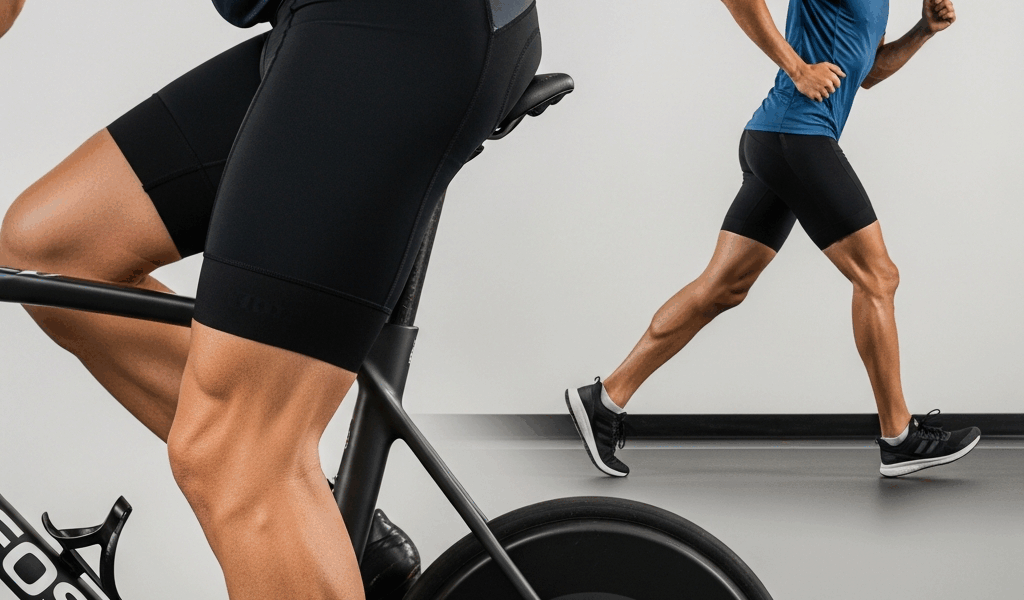
The Bike Fit and Run Collapse Connection
Triathlon run performance has gotten complicated with all the conflicting advice flying around. Coaches blame your run form. Gear companies blame your shoes. Training plans blame your volume. I spent three seasons pointing fingers at every possible culprit — my cadence, my stride, my run-specific fitness — while completely ignoring the thing that was actually destroying my legs before I even reached T2.
It was my bike fit. The whole time.
Here’s what took me embarrassingly long to understand. The position you hold for two, three, sometimes four hours on the bike doesn’t just evaporate the moment you unclip. It pre-loads certain muscles. It shuts down others entirely. By the time your feet hit the pavement, your neuromuscular system has already been shaped — and in some cases, broken — by whatever position you spent the last few hours locked into.
Most triathletes treat bike fit and run form as two completely separate problems. Get a bike fit to optimize watts and aerodynamics. Hire a run coach to fix the stride. But nobody connects saddle height to hip flexor fatigue, or aero position to glute shutdown. That connection is direct and biomechanical. It explains why certain athletes suddenly crush their run split after tweaking their bike setup — without changing a single thing about their run training.
If your run falls apart in the first mile of every race or brick workout, stop analyzing your running. Look at the bike first.
Saddle Height Is Compressing Your Hip Flexors
Probably should have opened with this section, honestly. I wasted an entire season convinced my hip flexors were just weak — bought a hip flexor strengthening program and everything. Turns out they weren’t weak. They were exhausted before I even started running.
Saddle height is the single most consequential bike fit variable for run performance. Get it wrong and your hip flexors spend hours in a shortened, pre-fatigued state. That’s not a small thing. That’s a race-ending thing.
A saddle sitting too high forces your hips to rock side to side just to reach the bottom of the pedal stroke. That rocking hyperextends your hip flexors on every single revolution. Multiply that by 5,000 or 6,000 pedal strokes over a 90-minute bike leg. The math is ugly.
The opposite problem is just as bad. A saddle too low keeps your hip angle closed at the top of the pedal stroke — hip flexors contracted, never lengthening, for the entire ride. They cross the dismount line in a state of constant tension. Then you ask them to lift your leg several thousand more times during the run. They simply won’t cooperate.
The tell is unmistakable. Short, shuffling stride the moment you step off the bike. Not weakness. Not bad run form. Just muscular exhaustion from a position your body was never designed to hold for hours.
Here’s a quick self-check worth doing today. Set your bike on a trainer — I use a Wahoo KICKR, though any trainer works — clip in with your foot centered over the pedal axle, and observe your knee angle at the very bottom of the stroke. Should be roughly 25 to 35 degrees. If you’re closer to 15 degrees, saddle is too low. Closer to 50 degrees, it’s too high. This single measurement has solved more bike-to-run problems than anything else I’ve tried.
Aero Position Is Shortening Your Run Stride
Aggressive aero positioning does something subtle and genuinely destructive — it forces a forward pelvic tilt that leaves your glutes in a mechanically disadvantaged position for hours.
Locked into a deep tuck — handlebars low, torso near-parallel to the ground — your pelvis rotates forward. Hip flexors shorten. Glutes lengthen. Fine for cycling. Your glutes don’t need to fire hard on the bike. But they absolutely do on the run, and by T2 they’ve been stretched and fatigued through the entire anterior pelvic tilt position you were holding.
The result is a crippled posterior chain. Glutes won’t engage during push-off. Stride becomes quad-dominant, shorter, inefficient. Hamstrings compensate and tighten. Lower back aches by kilometer three.
I learned this specifically at a 70.3 in Boulder — 2019, if it matters. I’d spent $620 on a professional fit at a well-regarded studio that prioritized aerodynamics above everything else. Bike split was solid, honestly one of my better ones. Run split collapsed before I hit the second kilometer. Felt like running through wet concrete. Glutes simply wouldn’t engage.
A physical therapist identified anterior pelvic tilt within about four minutes of watching me move. Her recommendation was straightforward: raise the handlebars 15mm, move the bar extensions slightly forward to back off the extreme tuck. Small adjustments. Significant difference at my next race.
This isn’t an argument against aerodynamics. It’s an argument for finding the aero position you can actually sustain without destroying your posterior chain. For most age-groupers, that means a slightly more upright position than the pros run — still fast, still aero, but biomechanically compatible with the run that comes after.
Cleat Position Can Wreck Your Run Knees
I’m apparently very sensitive to fore-aft cleat placement, and moving mine 3mm rearward completely changed my run knees while Speedplay’s default forward position never worked for me. Don’t make my mistake of assuming knee pain on the run is a running problem.
When cleats sit too far forward on the shoe, you extend your ankle more aggressively through the pedal stroke. Calves work harder. Knees operate at angles they weren’t built to sustain for three hours straight. Then you ask those same calves and knees to run a half marathon. They’re already spent.
Athletes buy expensive orthotics for this. New trainers. Compression sleeves. They’re treating a three-hour-old problem from cleat position as if it started at the run exit.
The trade-off is real and worth knowing. Forward cleat position preserves foot leverage — some power benefit there, genuinely. But it increases calf load and alters knee mechanics in ways that matter enormously post-bike. Rearward positioning reduces both, at a small cost to cycling efficiency.
For most age-group triathletes running after a long bike, the middle ground is your friend. Ball of the foot sitting roughly over the pedal axle — not in front of it. Enough cycling efficiency to matter, without the calf and knee penalty that compounds over the miles.
How to Test If Your Bike Fit Is the Culprit
While you won’t need a full laboratory gait analysis, you will need a trainer, a stopwatch, and about an hour of honest attention to how your body actually feels. So, without further ado, let’s dive in.
Run a brick workout. Forty-five minutes on the bike, immediately followed by ten minutes of running. Pay close attention to your first 800 meters on foot — that window tells you almost everything.
Stride short and shuffling, like your hips physically won’t open up? That’s saddle height causing hip flexor pre-fatigue. Glutes feel dead, quads doing all the work on propulsion? That’s aero position and anterior pelvic tilt. Knees already sore or calves impossibly tight before the first kilometer? Cleat placement is the likely culprit, loading your calves through the entire bike leg.
Once you’ve matched the signal to the cause, two options.
First, you should make small adjustments yourself — at least if you have a trainer and a basic understanding of your contact points. Raise or lower the saddle in 5mm increments. Shift cleat position 2 to 3mm forward or backward. Test in another brick. Small changes genuinely compound over time.
A professional triathlon bike fit might be the best option, as the bike-to-run transition requires nuanced position expertise. That is because most general bike fitters optimize for cycling alone — you want someone who explicitly understands that a triathlete’s position must survive a run. Tell them that upfront. The better ones already account for it. Expect to spend $200 to $400 for a quality triathlon-specific fit. Worth every dollar if you’ve already tried self-adjustments and keep struggling.
The realistic expectation here is simple. Fix the bike fit, fix the run — often without changing a single thing about your run training. No new shoes. No run coach. No hip flexor program. Just a position on the bike that stops pre-fatiguing the muscles you need for the miles that follow.


Stay in the loop
Get the latest triathlete today updates delivered to your inbox.