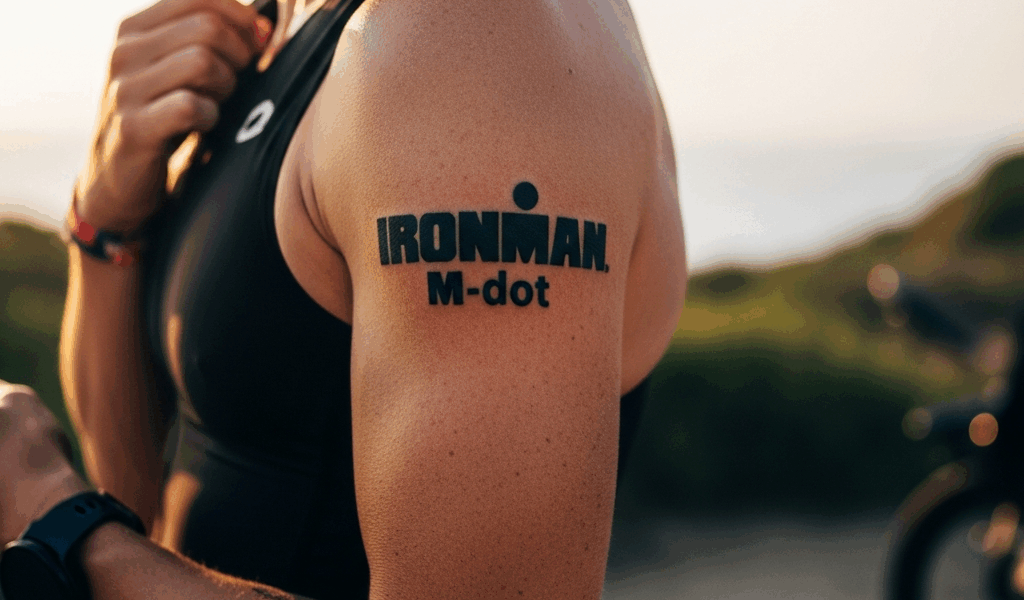
Ironman Tattoo Ideas — Designs That Earned Every Ink Drop
Ironman tattoo ideas have gotten complicated with all the generic listicles and Pinterest boards flying around. That probably sounds presumptuous — sketching M-dots before you’ve crossed the line. But three days after finishing, I was doing exactly that on a notepad at work, and I don’t regret a single needle drop. What I do regret is not thinking harder about design before sitting in the chair. Don’t make my mistake.
The M-Dot — What It Means and Where to Place It
But what is the M-dot, exactly? In essence, it’s the registered trademark of the World Triathlon Corporation — a red circle wrapped around a stylized M. But it’s much more than that. The WTC has historically been relaxed about finishers tattooing it, and within the triathlon community, it functions as a finisher’s mark. You covered 2.4 miles of open water, 112 miles on a bike, a full marathon. In that order. Clock running the whole time.
That’s what makes the M-dot endearing to us finishers. Another triathlete spots it on your calf at a coffee shop and immediately understands the 4 a.m. November training sessions, the gas station sandwich eaten on the bike because you miscounted calories, the swim workouts that felt like controlled drowning. No explanation required. That kind of silent shorthand is rare for any piece of body art.
Placement matters here more than with almost any other tattoo. The calf is traditional — almost protocol, honestly. Race photographers naturally shoot low, so your calf appears in finish-line photos without you doing anything deliberate. A lot of finishers treat the left calf as sacred real estate for exactly this reason. Shoulder and forearm placements are growing, especially for people building triathlon-themed sleeves — forearm M-dots typically run 2 to 3 inches and look sharp in a minimalist single-needle style. Shoulder placements give you room to grow additional elements around the core symbol over time.
Size recommendation from experience: don’t go smaller than 1.5 inches. Mine sits at about 2 inches on the outer calf — at that scale, the logo detail reads cleanly. Drop below an inch and the negative space starts filling in within five years. The ink won’t lie to you about that.
Distance and Time Tattoos
Probably should have opened with this section, honestly. Most people start here before they even know what they ultimately want — the time or date tattoo becomes the anchor, and everything else builds around it.
The 140.6 tattoo is the second most recognized mark in the sport, right behind the M-dot. Some finishers get it instead of the M-dot. Some get both. The number alone — bold, clean, sitting on a calf or forearm — reads immediately to anyone inside the sport and means absolutely nothing to anyone outside it. Some finishers prefer exactly that. It’s a private badge, not a billboard.
Finish time tattoos are deeply personal — and I love them for that reason. Getting your exact time permanently inked somewhere on your body is either obsessive or poetic depending on who you ask. In the triathlon world, it’s just honest. Something like 11:42:07 represents your body, your training, specific race conditions, one specific day in October. Fonts matter more than people expect. Clean sans-serifs — Helvetica Neue, Futura — keep numbers legible at small sizes without looking like a digital alarm clock. Script fonts look beautiful fresh but get harder to read as ink settles over years.
Date tattoos follow similar logic. Month, day, year of your finish. These often combine with a small M-dot or the 140.6 number into a compact design fitting roughly a 3-by-2-inch space. Minimalist approaches — thin lines, no fill, small scale — have dominated the last five years. Detailed shaded designs with drop shadows were more popular in the early 2010s and are making a quiet comeback, but they require a significantly more experienced artist and considerably longer healing time.
Course-Specific Designs
This is where Ironman tattoos stop being tribal and start being genuinely yours. Every race has a geography — and that geography can become ink. Kona is the obvious example: lava fields, volcanic rock coastline, the silhouette of Hualalai sitting in the background. A finisher who earned Kona gets something like that incorporated, and it tells a completely different story than a generic M-dot ever could.
Frustrated by how interchangeable most finisher tattoos looked, a lot of athletes started commissioning custom designs using local landmarks — a specific bridge crossed on mile 80 of the bike, a mountain profile visible from the run course, the pier they swam out from at 6:47 a.m. Ironman Lake Placid has Mirror Lake. Wisconsin has the Capitol building. Chattanooga has the Tennessee River bend. These details make the tattoo a map of a specific day rather than a symbol of a general achievement. This new approach took off several years later and eventually evolved into the course-specific custom work enthusiasts know and commission today.
Race number incorporation is underused and worth considering. Your bib number from your finish is locked to that race’s records permanently — incorporating it subtly, maybe worked into a design’s border or formatted alongside a date, adds a layer that only you and anyone motivated enough to look it up would fully understand. That appeals to a certain kind of finisher.
Bring reference photos to your artist. Ten, minimum. A custom specialist charging $200 to $300 per hour — someone working out of a shop like Bang Bang in New York, or any reputable custom shop in your city — will do better work with a stack of course photos than with your verbal description every single time.
First-Timer vs. Multi-Finisher Designs
First timers often want everything crammed into one tattoo — the M-dot, the time, the date, the course, possibly a motivational quote. That’s usually the mistake I’d gently push back on. A single clean M-dot or 140.6 leaves room to grow. The design you get after your first finish should have literal, physical space on your skin for what comes after it.
Multi-finishers have a tradition of star additions. Each star represents an additional 140.6 finish — the M-dot sits at center, stars orbit it, added over years, building into something that documents an entire athletic chapter of a life. Some athletes add a star after each return to the same race, tracking their annual relationship with a specific course. Others distinguish stars by race: different sizes for different courses, filled versus outlined, small variations that mean everything to the person wearing them.
While you won’t need a fully planned sleeve from day one, you will need a handful of intentional decisions made early. Building a tattoo portfolio over a triathlon career works best when you plan from the start rather than improvising backward. A sleeve built around milestones — first Olympic, first 70.3, first full, Kona qualification — can be extraordinary if the artist stays consistent across the work. Going back to the same artist matters enormously. I learned this the hard way after getting two pieces from two different artists that technically look fine separately but don’t visually speak to each other at all.
Placement and Sizing Guide
The calf placement is dominant for a reason. Race photographers shoot from mid-height or below — your calf is in virtually every finish-line photo you’ll ever own. The tattoo shows up without you doing anything to display it. That matters after a 140.6, because you’re not going to be flexing and posing. You’re going to be stumbling across the line wrapped in a mylar blanket while someone puts a medal around your neck, and that calf tattoo will be right there in the frame, doing its job.
Outer calf works best for bold designs, larger M-dots, combination pieces with numbers and dates. Inner calf is more intimate, suited to smaller personal pieces. The flat surface of the outer calf also means less distortion as the tattoo ages — important for anything with fine line work or small text that needs to stay readable a decade out.
Sizing reality check: a 2-inch M-dot with a date line underneath fits the outer calf without overwhelming it. A full course-specific scene with landmarks, distance, and time can run 4 to 6 inches and should be shaped to the natural muscle contour, not just positioned like a sticker. Your artist should stencil it first. Look at it in a mirror with fresh eyes. Walk around with it on for ten minutes before committing — this sounds excessive until you realize it isn’t.
Healing time creates a training conflict nobody warns you about clearly enough. Fresh ink on the calf means no swimming for a minimum of two to three weeks — chlorine on new ink causes fading and risks infection. No direct sun on the piece for at least a month. Most finishers time their appointment for the week immediately after the race, during the natural rest period, which lines up perfectly with both the healing window and the emotional high. Aquaphor Healing Ointment — about $4 for a 1.75-oz tube at any drugstore — remains the standard aftercare recommendation from most reputable shops. Apply it thin, not thick. I applied it too thick my first time, kept the surface too moist, and pulled ink out of the lines. The tattoo healed fine eventually, but the lines were softer than they should have been.
The tattoo you get for finishing an Ironman is different from anything else you’ll ever sit down for. Most body art commemorates something you love or something you are. This one commemorates something you did — something specific, measured, timed, and documented in a database somewhere. That’s worth more intention than a walk-in flash piece on a Tuesday. Take your time with the design. Find the right artist. And if you haven’t crossed the line yet — finish first. The ink will mean more.


Stay in the loop
Get the latest triathlete today updates delivered to your inbox.