Open Water Swimming Mastery: Conquering Your Fear and Building Speed
Open water swimming has gotten confusing with all the contradictory advice flying around. As someone who went from barely surviving my first sprint triathlon swim to actually enjoying race day, I learned everything there is to know about making peace with open water. Today, I will share it all with you.
The triathlon swim strikes fear into many athletes. Open water, mass starts, limited visibility, and the inability to stop make this the most psychologically challenging discipline for many triathletes. But that fear is manageable. I promise.
Understanding Open Water Fear
Fear in open water swimming is normal, rational, and manageable. Unlike pools with clear water, lane lines, and walls every 25 meters, open water offers none of those comforts. You are swimming in an environment where you cannot see the bottom, cannot touch the bottom, and cannot easily stop. Add dozens or hundreds of other swimmers and the physical stress of racing, and anxiety is completely understandable.
The key to overcoming this fear is gradual exposure combined with skill development. You cannot think your way out of open water anxiety – you must swim your way out. Each positive open water experience builds confidence that replaces fear.
The Psychology of Water Panic
When panic strikes in water, your body responds with fight-or-flight reactions: rapid breathing, muscle tension, tunnel vision, and impaired thinking. These responses make swimming harder, which increases panic – a dangerous spiral.
Breaking this cycle requires recognizing early warning signs: increasing breathing rate, shoulder tension, focusing on fear rather than swimming. When you notice these signs, you can intervene before panic takes hold.
Intervention techniques include: switching to backstroke to open your breathing; treading water while taking deep, controlled breaths; focusing on your stroke mechanics rather than your fears; reminding yourself that you have successfully swum this distance many times in training. That last one saved me more times than I can count.
Building Pool Competency First
Before tackling open water, ensure your pool swimming is solid. You should be able to swim 1.5-2 times your race distance continuously without stopping. For an Olympic distance triathlon, this means comfortable 2000-3000 meter swims in the pool.
Essential Technique Elements
Body position is the foundation of efficient swimming. Your body should be as horizontal as possible, with hips and legs riding near the surface. Many adults swim with their hips and legs dragging, creating massive resistance. The correction is usually head position: look straight down, not forward.
I am apparently one of those people who needed constant reminders about head position, and looking down works for me while thinking about my hips never did.
Your catch and pull should engage your entire core, not just your arms. Think of your hand entering the water, fingertips first, slightly outside your shoulder width. Extend forward fully, then catch the water by pressing down with your palm and pulling through with your entire arm as a unit while your body rotates.
The pull should finish at your hip, not under your belly. Early exit from the pull is one of the most common stroke errors. Your arm should brush your thigh as it exits the water.
Breathing should be relaxed and rhythmic. Exhale continuously underwater through your nose and mouth. Turn your head only enough to get air – one goggle should stay in the water. Lifting your head disrupts body position and creates resistance.
Building Endurance
Distance builds confidence. When you know you can swim 3000 meters in the pool, a 1500-meter race feels manageable. Structure your pool training to include at least one long swim per week, gradually building to 2000+ meters continuous.
Threshold work develops speed. Include sets at challenging but sustainable pace: 10x100m with 15 seconds rest, 5x200m with 20 seconds rest. These intervals should feel uncomfortable but doable.
Sprint work develops anaerobic capacity for starts and surges. Include short, fast efforts: 8x25m all-out with 30 seconds rest, 4x50m fast with 45 seconds rest. These prepare you for the intense first minutes of a triathlon swim.
Transitioning to Open Water
Your First Open Water Sessions
Begin your open water experience in calm, controlled conditions. Choose a lake, bay, or ocean with minimal current and waves. Swim with at least one partner or in a supervised setting. Use a brightly colored swim buoy for visibility.
Your first session should be about comfort, not distance or speed. Wade in up to your waist, splash water on your face, and simply float for a few minutes. When ready, swim just 100-200 meters parallel to shore, where you can stand if needed.
Notice the differences from pool swimming: temperature, visibility, the absence of walls, the different feel of natural water. Let yourself adapt without pressure.
Gradually extend your distance over multiple sessions. 200 meters becomes 400, becomes 800, becomes 1500. Each successful swim builds the experience bank that counteracts fear.
Sighting: The Essential Open Water Skill
Sighting – looking forward to check your direction – is the skill that separates pool swimmers from open water swimmers. Without lane lines, you must navigate by periodically spotting landmarks.
Probably should have led with this section, honestly. Sighting is that important.
The technique: integrate a slight head lift into your stroke, raising your eyes just above water level while your arm is pulling. This adds minimal resistance compared to lifting your entire head. Take a quick snapshot of your direction, then return to normal head position.
Practice sighting in the pool first. Every 6-8 strokes, lift your eyes to look at the end of the pool. This develops the coordination without open water complexity.
Sight on large, high objects: buildings, trees, hills – not just buoys. Buoys can be hard to spot in waves and are too low for reliable navigation. Use large landmarks in line with your intended course.
Sight frequently enough to stay on course but not so often that you disrupt your stroke. Every 6-10 strokes is typical. In rough conditions or crowded races, sight more often.
Drafting: Legal Speed
Unlike cycling, drafting is legal in triathlon swimming. Swimming directly behind another swimmer or at their hip can reduce your energy expenditure by 10-20% while maintaining the same speed.
To draft on feet: position yourself close enough that your head is near their feet, but not so close that you touch them constantly. You will feel the turbulence and can reduce your effort while matching their pace.
To draft on a hip: swim parallel to another swimmer, slightly behind, with your head at about their hip level. This is easier to maintain than feet drafting and offers similar benefits.
Drafting requires matching someone else’s pace. Choose a draft partner swimming at or slightly above your natural pace. Drafting behind someone faster will exhaust you; drafting behind someone slower wastes the advantage.
Race Day Swim Execution
Pre-Race Preparation
Walk the swim start area the day before if possible. Identify the start line, first buoy, swim course layout, and exit. Know exactly where you are going before the chaos of race morning.
Warm up before the swim if possible. Even 10-15 minutes of easy swimming gets blood flowing to swimming muscles and reduces the shock of cold water.
Position yourself appropriately for the start. Front-center is fastest but most aggressive – expect contact. Back-outside is calmest but longest distance. Choose based on your speed and comfort with contact.
The Chaotic First Minutes
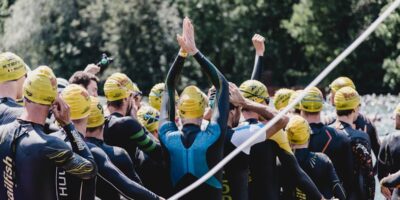
Mass swim starts are intense. Bodies everywhere, arms and legs colliding, limited visibility, heart rate spiking. Expect this and do not panic when it happens.
Start slightly easier than race pace. The first 100-200 meters will feel fast regardless because of adrenaline and crowd pressure. Settle into your rhythm rather than sprinting off the line.
If hit or grabbed, keep swimming. Contact is normal and rarely intentional. Getting upset wastes energy and focus. A tap on the feet is often a sign someone wants to pass – let them go if they are faster.
Find clear water as quickly as practical. Sometimes this means sprinting briefly to get ahead of a pack; sometimes it means easing off to let a pack pass. Clean water is faster than fighting through a crowd.
Main Set Swimming
Once the chaos subsides – usually within 300-400 meters – settle into sustainable pace. This should feel like strong aerobic effort: breathing hard but controlled, legs kicking lightly, arms pulling smoothly.
Sight regularly but not obsessively. Every 6-10 strokes is usually sufficient. Adjust more frequently around turns and if you notice you have been swimming off-course.
Find a drafting opportunity if possible. This is most effective in longer swims and races where you can identify someone swimming at your pace or slightly faster.
Stay relaxed. Tension in your shoulders, neck, and face wastes energy and disrupts stroke mechanics. Consciously relax your jaw, lower your shoulders, and soften your grip on each stroke.
The Finish and Transition
The final approach to the swim exit requires adjustment. Start kicking harder in the last 100-200 meters to get blood flowing back to your legs – they are about to run to transition.
As you approach shallow water, wait until you can touch bottom to stand. Standing too early and wading is slower than swimming. When you do stand, move quickly but carefully – the ground may be uneven and your legs will feel strange after horizontal swimming.
Advanced Open Water Skills
Swimming in Rough Conditions
Waves, chop, and current are facts of open water racing. Skilled rough water swimmers adapt their stroke and tactics rather than fighting conditions.
In choppy water: increase your stroke rate, shorten your stroke slightly, and breathe to the side away from oncoming waves when possible. Sight more frequently as waves can push you off course quickly.
In significant waves: time your breathing to the wave pattern, turning your head to breathe in troughs and exhaling as waves approach.
Cold Water Strategies
Water below 65F creates physiological challenges. Initial cold shock triggers gasping and elevated heart rate. Extended exposure leads to reduced coordination and power output.
Preparation: practice in cold water during training. Your body acclimates somewhat with repeated exposure. Use a properly fitted wetsuit that minimizes water entry.
Race day: warm up thoroughly on land before entering cold water. When you enter, put your face in the water immediately – this triggers the diving reflex and helps manage the initial shock. Start conservatively as your heart rate will be elevated initially.
Building Your Open Water Practice Plan
If possible, swim in open water at least once per week during the 8-12 weeks before your race. More is better, but consistency matters more than volume.
Structure open water sessions like you would pool sessions: warm-up, main set, cool-down. Include specific skill work: sighting drills, drafting practice with partners, starts from standing in shallow water.
Simulate race conditions when you can: wear your race suit, practice your nutrition strategy, rehearse your wetsuit removal technique. The more familiar race day feels, the more mental energy you have for racing.
Join a local open water swimming group if available. Swimming with others is safer, more motivating, and provides drafting practice opportunities you cannot get alone.
The Mental Game
Ultimately, open water swimming mastery is as much mental as physical. The athlete who stays calm, focuses on execution, and trusts their preparation will outperform the more physically gifted athlete who succumbs to panic.
Develop race mantras: short phrases you repeat when stressed. Smooth and steady. I have done this before. One stroke at a time. These mantras redirect anxious thoughts toward useful focus.
Accept imperfection. Every race has moments of difficulty – getting kicked, swallowing water, swimming off course. Skilled open water swimmers do not avoid these moments; they handle them and move on without losing focus.
With practice, patience, and gradual exposure, the triathlon swim transforms from a source of anxiety to a strength. You may never love it the way you love cycling or running, but you can become competent, confident, and fast. And when you exit the water knowing you have swum well, the bike and run ahead feel full of possibility.