Why Your Neck Gets Destroyed in Open Water
Wetsuit neck chafing has gotten complicated with all the conflicting advice flying around. As someone who spent three full seasons blaming the wrong thing entirely, I learned everything there is to know about what actually destroys your neck in open water. Today, I will share it all with you.
Here’s the short version: pool swimming keeps your head relatively still. Open water doesn’t. Every single breath cycles your neck against neoprene — hundreds of times per hour. That friction alone will wreck your skin. Then salt water enters the equation and makes everything exponentially worse. It stings mid-swim. It burns even harder on the run when sweat hits raw, abraded skin.
The collar area takes the worst of it. Most wetsuits have a reinforced neck panel designed to create a water seal — and that seal creates concentrated pressure points. Add horizontal rotation from sighting and breathing, throw in vertical movement from chop, and you’ve basically engineered a chafe machine. Congratulations.
Cold water forces thicker neoprene, which means more friction. Warm water races aren’t any better — thinner suits have to fit tighter at the neck to prevent flushing. Either way, your neck loses.
Anti-Chafe Products Ranked by What Actually Lasts
Probably should have opened with this section, honestly. Product choice genuinely matters here — most options fail spectacularly by mile one. I’ve tested nearly everything on the market. Here’s what I found.
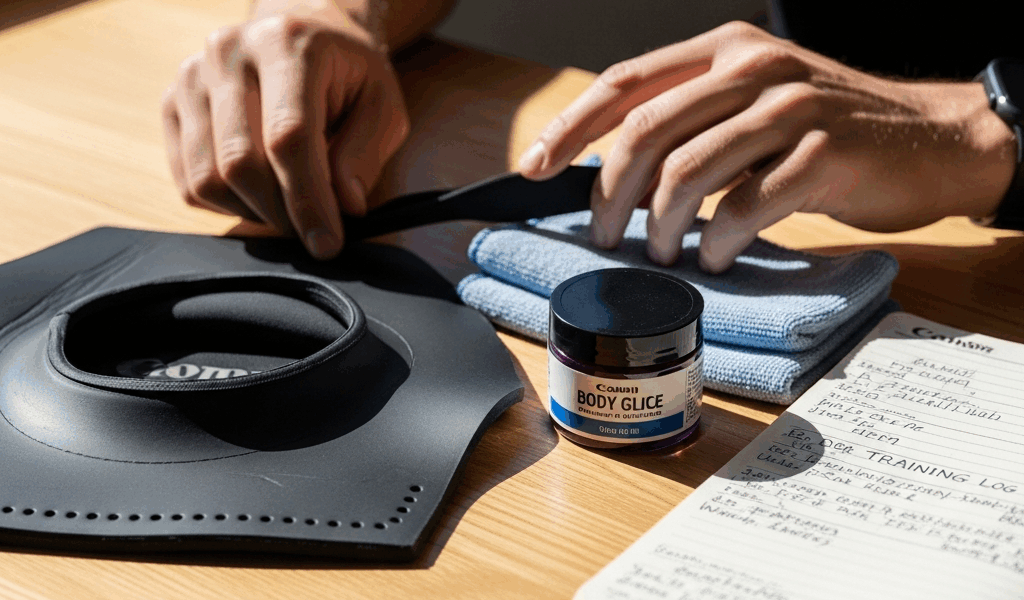
Body Glide and Similar Wax Sticks
Body Glide runs about $7–9. It washes off in salt water within 15–20 minutes. I used it for two full years convinced my application technique was wrong. It wasn’t. The product just can’t survive prolonged submersion. Fine for sprint distances or pool triathlons under 45 minutes. Beyond that — don’t bother.
Trislide and Thicker Formulations
Trislide ($12–15) has a heavier, greasier base and survives considerably longer — roughly 60–90 minutes before breaking down. The catch: it’s spectacularly messy. I’ve permanently stained three race shirts and two pairs of goggles. It works, but it’s expensive in ways that go well beyond the sticker price.
Aquaphor and Petroleum-Based Ointments
Aquaphor ($4–6) holds up surprisingly well in salt water — genuinely viscous stuff. But it’s petroleum-based. Petroleum eats neoprene. I noticed my collar getting sticky after using it regularly, then tacky, then visibly degrading. Your wetsuit costs $600. Don’t save $5 by destroying it. Avoid anything petroleum-derived on your suit, full stop.
Coconut Oil
Coconut oil ($8–12) works better than expected. Natural, cheap, survives open water reasonably well. The downside is your entire race kit will smell like a tiki bar for three days afterward. More importantly, it’s not formulated for movement-based chafing specifically — it provides general slickness, not targeted protection. Use it if nothing else is available. Don’t make it your primary strategy.
Specialized Triathlon Lubes
Products like Huub Openwater ($14–18) and Squirm ($16–20) are designed specifically for wetsuit chafing. They last the full swim. They handle salt water. They won’t degrade neoprene. I’m apparently a heavy chafter and Squirm works for me while Body Glide never did — not even close. Used it for my last two 140.6 races. Zero neck chafing. That’s what makes specialized formulations endearing to us long-course athletes. Worth every penny, and then some.
The Application Rule
Whatever product you choose, apply it thick. Create a visible layer — don’t just lightly coat. Hit your neck, collarbone, and the first few inches of your chest. Reapply along the collar line right before entering the water. One pass won’t cut it for long-course racing.
The Rash Guard Solution
Worn beneath your wetsuit, a thin rash guard eliminates chafing entirely. This is the nuclear option. It works. Full stop.
But what is a rash guard solution for chafing, exactly? In essence, it’s a thin fabric barrier between your skin and the neoprene — removing friction from the equation entirely. But it’s much more than that; it doubles as insulation in cold water races, which we’ll get to. A men’s rash guard runs $25–45. Women’s versions cost $30–50. Compare that to weeks of recovery and the real risk of infection from open sores, and it’s cheap insurance.
Sizing and Fit Under the Suit
A rash guard worn under a wetsuit must be snug — at least if you want to avoid bunching and pressure points. Size down from your normal size. Medium? Buy small. Try it on with your actual race wetsuit before race day. Non-negotiable.
No bunching. No lumps under the neoprene. You should be able to raise both arms overhead without the combined layers strangling your shoulders. Spend 15 minutes in the pool testing this combination. Finding problems in practice beats finding them at the starting line — trust me on that one.
The Warmth Question
An extra fabric layer adds insulation. In cold water, that’s free thermal protection. In warm water, it’s a liability — you’ll overheat enough to slow down noticeably.
For any race above 72°F, skip the rash guard unless chafing has genuinely brutalized you before. Use product and fit adjustments first. Below 68°F, add the rash guard without hesitation. Warmth plus protection in a single $35 purchase.
Brand That Works
I’ve used Xcel and O’Neill rash guards under race suits without issues. Both are durable, fit true to size once you size down, and don’t pill or degrade after 30–50 wears. Buy a quality version — not the $12 knockoff from Amazon. A decent rash guard lasts multiple seasons.
Wetsuit Fit — the Root Cause Nobody Addresses
Wetsuit fit has gotten overlooked with all the product talk flying around. Your chafing often isn’t about lubricant at all. It’s about a collar that doesn’t fit your neck correctly — and no amount of Squirm fixes that.
Excess neoprene bunches and creates rolling friction with every stroke. A collar that’s too loose allows constant water circulation. One that’s too tight restricts breathing and amplifies friction. Both scenarios shred your neck.
The Two-Finger Test
Stand in your wetsuit. Have someone slide two fingers between your skin and the collar. Snug, but not comfortable. That’s the target tension.
Three fingers fit easily? The collar is too loose — water flushes constantly. Can’t fit one finger? It’s strangling you. Breathe normally. If you catch yourself holding your breath even slightly, the suit is too tight.
When to Size Down
Most triathletes buy wetsuits one size too large — prioritizing comfort on land over performance in water. The suit feels fine in the parking lot. In water, where buoyancy and compression actually matter, it’s baggy. The collar flaps. It chafes worse.
If you’ve been wearing a size large and dealing with consistent neck chafing, try a medium. Go to a shop that stocks multiple sizes. Do actual arm circles. Simulate a swimming stroke. The right size feels snug without cutting off circulation. This matters more than any product you’ll ever buy. Don’t make my mistake of shopping online and guessing.
Trimming the Collar
If you own a suit that fits everywhere except the neck, you can trim it. Cut a thin strip — start with 1/4 inch — from the very outermost edge of the collar. Only the edge that contacts skin. Not structural neoprene.
I trimmed my Xterra Volt after my first season. Reduced chafing by roughly 70%. A $200 suit became genuinely usable again. Trimmed wetsuits look slightly rough around the edges — they work anyway.
Build Tolerance Before Race Day
Your skin adapts. Calluses form at friction points. That adaptation takes time — time most triathletes don’t give it.
Frustrated by repeated micro-injuries during my first Ironman attempt, I learned the hard way about pre-race skin conditioning. I wore my suit twice in the pool and then debuted it at the race. The outcome was predictable. I finished the swim with bleeding neck skin. That was 2019. I haven’t made that mistake since.
So, without further ado, here’s what I do now: five pool swims in any new gear. Four full training sessions plus a 20-minute shake-down swim the week before. That’s roughly two hours of total exposure. Skin thickens. Pain decreases. Race day chafing becomes minimal instead of catastrophic.
This new approach took hold several seasons later and eventually evolved into the pre-race conditioning protocol triathletes know and rely on today. Don’t debut a new wetsuit on race morning — ever. If you received gear as a gift or upgraded late in the season, you’re gambling. Put in the pool time first.
The Progressive Approach
Start with 10 minutes in your suit. Graduate to 20. Move to full workouts. Each session conditions your skin without overloading it. You’re not trying to cause injury — you’re training skin to resist it.
During these practice swims, use whatever anti-chafe product you plan to race with. Test it under actual conditions. See how long it lasts. See how it feels at the 45-minute mark. Race day won’t reveal anything your training didn’t already show you — at least if you put in the work beforehand.
Neck chafing in triathlon isn’t inevitable. It’s the predictable result of a specific combination: friction mechanics, product failure, poor collar fit, and untested equipment. Address all four and you’ll cross that finish line with your skin intact.




Stay in the loop
Get the latest triathlete today updates delivered to your inbox.