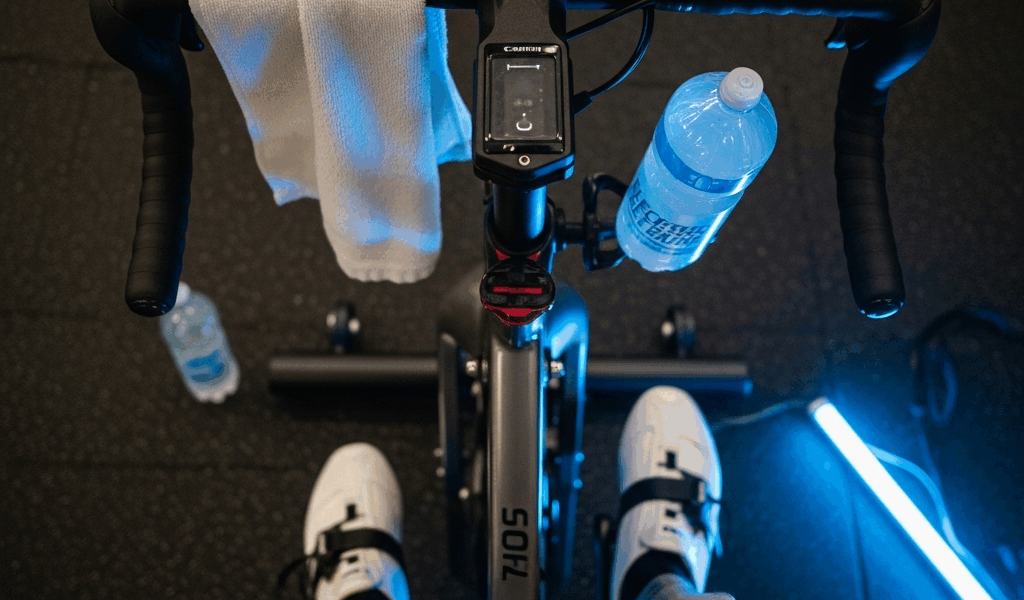
What Actually Happens to Your Body in T1
Triathlon transitions have gotten complicated with all the conflicting advice flying around. So let me cut through it — because what actually happens to your body between the swim and the bike is genuinely weird, and most athletes have no idea they’re sabotaging themselves before they even clip in.
Cold water does something specific to your blood vessels. Spend 20–40 minutes in a lake at 68°F and your peripheral vasculature clamps down hard, rerouting blood toward your core. That’s just your body keeping your organs warm. Fine. The problem is that when you climb out of the water, that clamping doesn’t stop. It lingers — another 10–15 minutes on the bike — while your legs are essentially waiting in line for oxygen that isn’t arriving yet.
Then the position change hits. Horizontal in the water. Upright on the bike. That shift alone changes how blood returns to your heart from your legs. Studies on triathlon-specific transitions have measured a 10–15% power deficit in the first 10 minutes on the bike. Most of that loss comes down to blood pooling in the lower body during those early minutes. Your legs have the muscle. Your cardiovascular system just won’t courier the oxygen to use it.
But what about sodium? In essence, it’s your blood volume manager. But it’s much more than that. You’ve been sweating since you zipped up the wetsuit — electrolytes, especially sodium, bleeding out the whole time. By the time you mount the bike, plasma sodium has already dropped. Low sodium means your body can’t hold onto fluid. Low fluid means lower blood volume. Low blood volume plus upright posture plus cold-constricted vessels equals legs that feel like someone poured concrete into them.
The Watts You Are Losing and Why It Matters
Most age-group athletes drop 40–80 watts in the first 10 minutes on the bike. That’s not a rounding error. If you’ve tested at 280 watts on fresh legs, you’re suddenly pushing 220. A 14% reduction — right at the moment consistency matters most.
Here’s the mistake I see constantly. Athletes panic. They feel weak, assume they’re undertrained, and smash the first 10 minutes trying to “wake the legs up.” This backfires badly. Hard early efforts pull fast-twitch muscle fibers into the equation, fibers that demand more oxygen precisely when oxygen delivery is already compromised. You burn matches you’ll desperately need at miles 40–60. Heart rate spikes. The effort feels harder than the power output justifies — because it is.
That early power drop echoes into the run, too. Your legs arrive at the run already fighting fatigue from a compromised aerobic system on the bike. The run doesn’t hurt because you ran badly. It hurts because you spent the bike leg chasing watts you couldn’t actually access, draining glycogen and sodium in the process. That’s what makes a smart T1 strategy so endearing to us age-groupers who don’t have unlimited recovery buffer to burn.
Fix the Swim Exit Before You Even Mount the Bike
Most athletes treat T1 as a transition zone. Treat it as an activation zone instead.
The moment your feet touch the ground coming out of the water — arms first. Peel the wetsuit down to your waist while walking. Not after you reach your bike. While walking. Keeping neoprene across your shoulders and upper back restricts venous return from your upper body. That extra 15 seconds of early wrestling costs you more in blood flow than it saves on the clock.
Once it’s off, do 20 high knees in place. Not jogging. Explosive knee drives. This isn’t warm-up in the traditional sense — it’s a signal. High knees activate your hip flexors and glutes, which tells your nervous system you’re switching from horizontal to vertical. Your proprioceptive system recalibrates. Blood starts redirecting toward the muscles you’re about to demand.
Then 10 walking quad stretches — heel pulled hard toward your glute, one second hold per rep. This opens the hip and lengthens the psoas, which is almost certainly shortened from the swim stroke. A tight hip flexor restricts your pedal stroke and makes your legs feel even more like dead weight.
Run to your bike. Not jog. Run. Probably should have opened with this section, honestly — because when I first added this full sequence, my first 10-minute power jumped 12 watts consistently. That’s 4–5% from activation alone, no fitness gains required. Don’t make my mistake of skipping this for three seasons because it felt unnecessary.
How to Ride the First 10 Minutes Without Killing Your Race
Mount with a target cadence of 95–105 RPM. Easy gear — two gears easier than your instinct says. Not your race gear. Not your ramp-test gear. The gear that feels almost embarrassingly light.
Higher cadence recruits slow-twitch muscle fibers preferentially. It forces blood into the legs without requiring maximum force production. You’re asking your cardiovascular system to deliver oxygen while asking your muscles to use it efficiently. Low cadence plus high force does the opposite — it bottlenecks blood flow to the extremities and makes the whole situation worse.
Set a hard power ceiling for those first 10 minutes: FTP minus 10%. If your FTP is 280 watts, that’s 250 maximum. Not 251. Not “one little push.” 250 is the line. You’ll feel slow. Athletes will pass you. I’m apparently hypersensitive to that social pressure — it used to destroy my pacing every time — but holding the ceiling works for me now while chasing the pack never did.
At 12–15 minutes, reassess. Your power will have improved. Increase gradually toward race pace. The athletes who cruised past you in those early minutes? You’ll often find them again on the run — because they spent their buffer before they knew they needed it.
Nutrition and Sodium Timing That Restores Power Faster
Sodium within the first 5 minutes on the bike. Not kilometer 5. Minute 5. I use SaltStick caps — 1 tab per 250ml water. GU Roctane gels carry 200mg sodium per packet if you’d rather consolidate. Either works. The point is blood volume restoration, and water alone won’t get you there fast enough.
Pair the sodium with fast carbs — 15–20g in that first administration. Glucose uptake is suppressed during the blood pooling phase, so quick carbs matter here more than at any other point in the race. A gel with electrolytes handles both in one bite. That’s what I carry in the right jersey pocket at every race, stuffed in during T1 setup the morning before start.
But what is plasma osmolality, really? In essence, it’s the concentration balance that determines how well your blood holds onto fluid. But it’s much more than that — it’s the gating mechanism controlling your power recovery. Sodium and carbs consumed early restore that balance by minute 8–10, landing exactly when your power starts coming back naturally anyway. You’re not manufacturing watts from nowhere. You’re accelerating the return of watts that were always there, just locked behind a physiological gate your nutrition can help open.
So, without further ado, here’s your race protocol: Exit swim — peel wetsuit immediately, arms first. 20 explosive high knees. 10 walking quad stretches, one second each. Run — actually run — to your bike. Mount at 100 RPM, two easy gears, power capped at FTP minus 10%. At minute 2–3, take sodium plus fast carbs. Hold the ceiling until minute 10. Ease toward race pace at minute 12. Your legs will respond like someone flipped a switch — because physiologically, that’s almost exactly what’s happening.

Stay in the loop
Get the latest triathlete today updates delivered to your inbox.