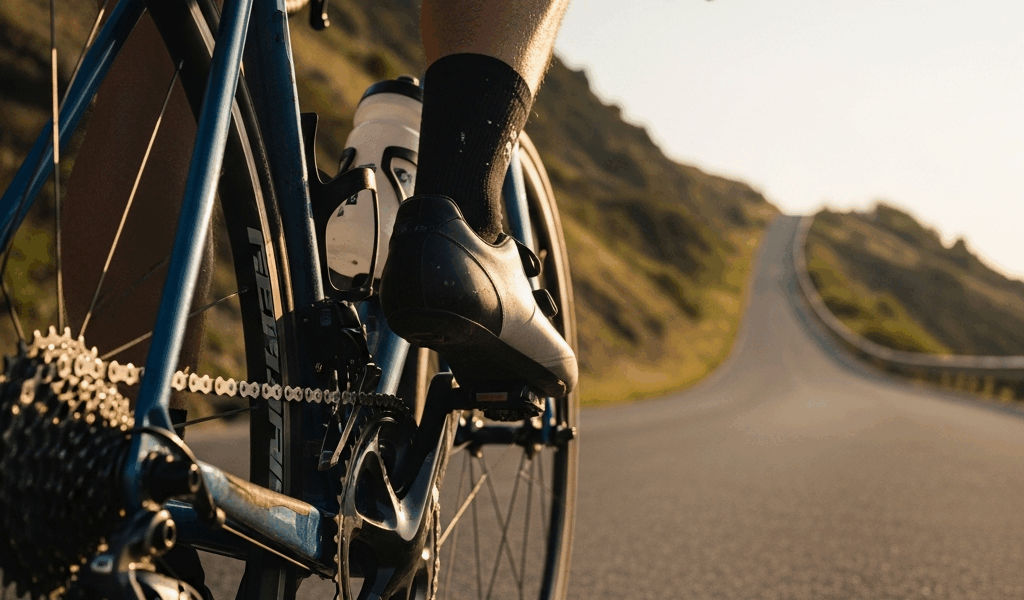
The Cadence Collapse Feels Different Than Normal Fatigue
Why your cycling cadence drops on long climbs is something I didn’t fully understand until my second triathlon. Halfway through a two-mile climb, I watched my average RPM tank from 92 down to 78 while my perceived effort barely budged. I was pushing just as hard — my legs weren’t screaming in lactate burn — but they felt like they were moving through cement.
This is the cadence collapse. Not bonking. Not a fitness issue. It’s specific.
You’ll notice it during sustained climbing when your pedal speed drops 10–15 RPM despite maintaining the same power output or even increasing effort. The problem isn’t that you’re tired in the traditional sense. Your heart rate might be steady. Your breathing controlled. But the rhythm of your pedal stroke fragments, your legs hunt for a slower gear, and you lose momentum on the climb itself.
For triathlon athletes, this matters more than it does for pure cyclists. Every second lost on the climb compounds — you’re already managing residual fatigue from the swim, your legs are primed for the run, and climbing inefficiency costs you time you can’t reclaim later. A 30-second loss on a climb becomes a three-minute deficit by mile 5 of the run.
The cadence collapse isn’t just leg fatigue dressed up differently. It’s a combination of bike fit, gear selection, core stability, and training specificity colliding on a sustained gradient. Probably should have opened with this section, honestly — it would’ve saved me from two races of wondering what was wrong.
Reason 1: Your Bike Fit Is Too Aggressive for Climbing
Triathlon bikes sacrifice climbing comfort for aerodynamics. That’s not a weakness — it’s a design choice. But the geometry that keeps you slammed in aero on the flats creates a mechanical disadvantage when the road pitches up.
Your seat tube angle on a triathlon-specific frame sits steeper than a road bike. We’re talking 75–77 degrees versus 73–75. Your reach is longer. Your drop bars pull you forward. Together, these compress your hip angle and restrict hip extension — the exact motion you need to generate power on a climb. When your hip can’t extend fully, your glute and hamstring can’t fire efficiently, so your quads compensate. Your quads fatigue faster at lower cadences, your pedal stroke slows, and momentum dies.
Here’s the diagnostic: on your next climb, stand up and focus on your knee. Is it tracking directly over your pedal axle, or is it drifting forward? If your knee tracks ahead of the pedal axis, your seat is too far back or too low. That forward position forces your quads to work harder and your hips to work less — exactly backward for climbing efficiency.
The micro-fix is immediate. Try moving your seat forward 5 millimeters on the rails — not a full centimeter, just five. Then move down one notch on your drop bar spacer stack to reduce reach by roughly 10 millimeters. Do this on an easy climb and pay attention to how your hip feels at full extension. You’re hunting for a position where your knee tracks over the pedal axis and your hip feels “open” — not compressed.
This isn’t about rebaselining your fit entirely. It’s a tactical adjustment for climbing that you can dial in within 15 minutes on a trainer.
Reason 2: You’re Using Too High a Gear Too Early
Gear selection on climbs operates like compound interest, except in reverse. Start in a gear that’s too hard, and your cadence falls. Lower cadence means higher force per pedal stroke. Higher force means faster glycogen depletion in your quads. Faster depletion means your legs can’t sustain that gear for long, so you shift down anyway — but now you’ve already burned matches you needed for the sustained effort.
Most triathletes grind. They choose a gear that feels “productive” — something where they feel resistance, where they feel like they’re working. That’s often 70–80 RPM on a climb. It feels good for the first three to four minutes. Then their cadence creeps lower because they’re accumulating fatigue faster than a higher-cadence approach would allow.
The optimal climbing cadence for triathlon sits in the 85–95 RPM range, even on sustained grades. Spin-up strategy — choosing a gear light enough that you can maintain 88 RPM on the climb — distributes the workload across more muscle fiber, reduces peak force demands on your quads, and preserves your ability to hold that effort for longer.
Your next climb, try this: shift to a gear where you hit 88 RPM and hold it for 30 seconds before deciding if it’s right. Don’t shift based on how light it feels. Shift based on whether you can sustain 88 RPM for the entire climb. You’ll climb faster and lose less time to the cadence collapse.
Practice gear selection on one training climb per week. Pick the same climb, same time of day if possible, and test different gears at different efforts. You’ll develop intuition for which gear pairs with which gradient and effort level — and you’ll arrive at race day knowing exactly what your cassette should feel like at climbing pace.
Reason 3: Core Fatigue From the Swim Is Destabilizing Your Pedal Stroke
Fueled by the effort of a 1500-meter swim, triathletes mount the bike with abdominal muscles and lower back stabilizers already partially fatigued. This is the specific physiological cost of the swim-to-bike transition that pure cyclists never face.
Your core does one job on the bike: it stabilizes your torso so your legs can generate power into a fixed frame. When your core fatigues, your torso shifts laterally on the saddle. Your hips rock side to side. Your pedal stroke loses efficiency because you’re now using leg muscles to stabilize your body as well as to drive the pedals. That dual demand exhausts your legs faster, your cadence drops, and the collapse accelerates.
On climbs, where you’re standing out of the saddle and generating force from your hips forward, core stability becomes critical. If your core can’t hold your pelvis steady, your hip extensors can’t generate maximum force, and you’re forced to use a lower cadence at higher effort just to maintain momentum.
Two drills that mimic climbing core demand: first, the plank-to-downward-dog. Hold a plank for 30 seconds, then shift to downward dog, then return to plank. Do three rounds, three times per week. This teaches your core to stabilize through hip extension — the exact motion your core needs to control on a climb. Second, the dead bug: lie on your back, extend one arm and the opposite leg, return, and alternate. Twenty reps, three sets. This works your anterior core in a lengthened position, which is closer to climbing physiology than crunches are.
Brick workouts amplify this issue. After a run, your core is already depleted. If you add a climb to the bike portion of a brick workout, you’re training the exact scenario you’ll face in a race. Do one brick per week with at least one sustained climb on the bike portion, and pay attention to your cadence across that climb. This teaches your body to stabilize your core under realistic triathlon fatigue.
Reason 4: Your Training Isn’t Teaching Your Legs to Climb at Tempo
Most triathletes train climbs at two intensities: easy spinning or all-out efforts. Steady-state climbing — holding a moderate-to-hard effort for five to ten minutes — rarely shows up in structured workouts. That’s the training gap.
Tempo climbing is where cadence control becomes automatic. When you sustain a hard effort on a climb for five minutes straight, your body adapts to holding a specific cadence at that effort level. You stop hunting for gears. Your neuromuscular system learns to “lock in” at 88 RPM and maintain it regardless of micro-variations in gradient. That adaptation doesn’t happen on easy climbs or sprints. It only happens under sustained pressure.
Here’s a workout that teaches it: three repeats of five-minute climbing efforts at your estimated 70.3 race pace intensity — roughly 85–90% of functional threshold power — with two minutes of easy spinning recovery between repeats. Do this on a climb that averages 4–6 percent grade. On the first repeat, intentionally start at 92 RPM to establish a baseline. Pay attention to where your cadence settles by minute four. On repeats two and three, try to match that cadence from the start. By the end of the third repeat, your body knows what 88 RPM at race effort feels like on a climb.
Do one session like this every ten days during your base and build phases. By race day, climbing at cadence becomes automatic. You won’t think about it. Your legs will just know.
The Fix: Test Your Cadence Before Race Day
Two weeks before your race, run a pre-race audit. First: bike fit check. Visit a fitter who understands triathlon climbing or use the knee-tracking diagnostic I mentioned earlier. Dial in a five-millimeter seat adjustment and test it on a short climb. Second: gear ratio verification. Map the course profile, identify the steepest sustained climb, and confirm your cassette can support 85 RPM on that gradient. If not, consider swapping your cassette — a $40 part on most bikes. Third: practice the actual climb at race pace, one time, at the same time of day as your race if possible. Do this one week out, so you have time to adjust anything that feels off.
The cadence collapse is triathlon-specific because it’s rooted in the interaction between bike design, pre-race swim fatigue, and climbing-specific training. Generic cycling advice about “pushing hard” misses the fact that you’re managing three sports in one day. These fixes target the overlap.

Stay in the loop
Get the latest triathlete today updates delivered to your inbox.