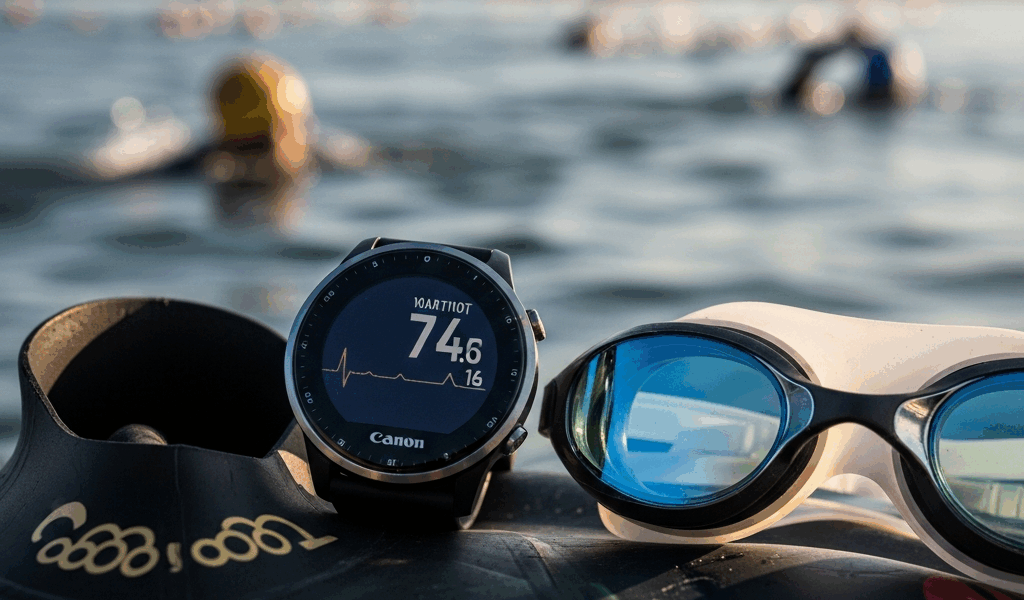
What’s Actually Happening Inside Your Body at the Start Line
Triathlon start lines have gotten complicated with all the misinformation flying around. Everyone’s got a tip. Everyone’s got a hack. But almost nobody explains the actual physiology — and that gap is where races get destroyed before they even begin.
So let me back up. The moment you step into transition, your body floods with adrenaline. Heart rate spikes. Sometimes 20 beats. Sometimes 50. In a matter of seconds. This isn’t weakness or a sign you’re undertrained. It’s your sympathetic nervous system doing exactly what it was built to do — firing a primal alarm that says something important is about to happen. Your brain registers the noise, the crowd, the cold water ahead, the months of training on the line. It dumps catecholamines — epinephrine, noradrenaline — straight into your bloodstream. Your heart has no choice but to respond.
But what is cardiac anticipation? In essence, it’s your body beginning to prepare for race effort before any effort has actually started. But it’s much more than a simple pre-race jitter. We’re talking 10 minutes before the gun goes off. You’re standing in transition thinking about the swim. Your nervous system is already mobilizing. Blood pools toward your muscles. Heart rate creeps upward. Then the announcer starts the countdown. Then the horn. That’s when the spike becomes genuinely difficult to control — unless you’ve put in the work to train your nervous system first.
Why the Swim Makes Everything Worse
Open water isn’t a pool. I want to be very clear about that. It’s 200 strangers, shoulder-to-shoulder, kicking at your face. Someone grabs your ankle. A wave fills your mouth. The buoys are nowhere you expected them to be. Your elevated heart rate — already a problem — now becomes a real liability.
Then add cold water. Most open water races sit below 15°C. The moment you enter, your body triggers cold shock response. Breathing becomes involuntary and rapid. Core muscles tense up hard. Heart rate spikes again, stacked directly on top of the adrenaline spike you were already managing. You’re at 170-plus bpm before you’ve swum 50 meters. That was before anything went wrong.
The face immersion reflex compounds this further. Cold water hitting your face triggers the diving response — an ancient mammalian reflex that slows your heart and reroutes blood toward vital organs. Sounds helpful. It isn’t. Not during a mass-start when you’re already hyperventilating. What you get instead is a dangerous rhythm: rapid, shallow breathing interrupted by involuntary breath-holds. Your body is essentially arguing with itself.
Here’s what plays out most often. Someone exits the water and realizes they’ve blown up completely. They swam the first 200 meters at a pace that felt totally normal — but normal at 180 bpm is unsustainable for the remaining 1.9 km. Lactate-soaked before they hit open water. The bike is gone. The run becomes a shuffle. That’s what makes this problem so particularly damaging to age-groupers — perceived effort and actual effort diverge completely during an adrenaline dump. Your brain lies to you at the start. What registers as moderate effort is actually hard. Really hard.
The Pre-Race Warm-Up That Actually Works
You need a three-part morning protocol. Not vague guidance about deep breathing. Specific movements, timed precisely. So, without further ado, let’s dive in.
Part One — Activation (45 Minutes Before Your Wave)
Spend 10 minutes on easy movement. Walking. Light jogging. Arm circles. Nothing heroic. The goal is nudging your heart rate up to roughly 120–130 bpm in a controlled, gradual way. Your cardiovascular system needs to reach that new normal before race effort begins. If you’re sitting in transition until the gun fires, you’re starting from zero — and your heart has nowhere to go except straight up, fast.
Part Two — Swim Warm-Up (15–20 Minutes Before Your Wave)
If the race allows water entry before your wave, get in. Don’t thrash around. Swim 200–300 easy meters. Let your body acclimate to the water temperature — get your face wet, practice a few strokes, feel how the water moves. This desensitizes the cold shock response and lets you experience actual conditions while adrenaline is still at a manageable level.
If there’s no warm-up swim — and many races forbid it — do dry-land activation instead. Swim motions standing up. Push-ups. Arm swings. Torso rotation. Anything that wakes up your shoulders and engages your core before you’re thrown into chaos.
Part Three — Breathing Protocol (10 Minutes Before Your Wave)
Box breathing. Inhale for 4 counts. Hold for 4. Exhale for 4. Hold for 4. Ten full rounds. This activates your parasympathetic nervous system — essentially your body’s brake pedal. Your heart rate won’t drop dramatically. But you’ll interrupt the adrenaline cascade. You’ll feel anchored rather than spinning out.
Do this at the water’s edge, not back in transition. You want breathing controlled and mind quiet when the announcer begins counting down. Location matters more than most people realize.
How to Race the First 400 Meters Without Imploding
Probably should have opened with this section, honestly. Everything above fails if you don’t execute the first 400 meters correctly. All of it.
Start from the back of your wave. Or even slightly late. I know every instinct in your body resists this. Position matters, sure — but your finishing time does not hinge on where you are at the 200-meter mark. What actually matters is space. Find open water around you. Not wedged between two athletes fighting for identical lines. The mental clarity that comes with open water around you is worth surrendering 30 seconds on seeding. Easily.
For the first 100 meters, ignore your watch. Don’t look at your heart rate monitor. Use Rate of Perceived Exertion — RPE. On a 1-to-10 scale, you should feel like you’re at a 5 or 6. Breathing slightly elevated but controlled. If you’re gasping, you went out too hard. Back off 10 seconds per 100 meters from your goal pace. Yes, 10 seconds feels enormous. It is also the difference between exiting the swim with something left in the tank and exiting completely destroyed.
Pick a mental anchor and use it. Something like “Smooth and easy. Let them go.” Repeat it every 50 meters. Other swimmers will pass you in the first 200. This is fine — it’s actually psychological gold. Let them burn their matches early. You’ll see them again on the bike, and it won’t be a pleasant reunion for them.
By 400 meters, something shifts. Your body has acclimated. Heart rate is still elevated, but it’s no longer spiking upward. Breathing normalizes. A rhythm appears. From that point forward, the swim becomes execution — not survival. That’s what makes this pacing approach so valuable to triathletes who’ve struggled with blow-ups. The patience required in those first few minutes pays dividends across the entire remaining race.
When a High Starting Heart Rate Might Be Telling You Something Else
If your resting heart rate is sitting more than 10 bpm above your normal baseline on race morning, something is off. Overtraining. Low-grade illness. Sleep deprivation. Too much caffeine — and seriously, skip the pre-race coffee if you’re already jittery. I’m apparently extremely caffeine-sensitive and skipping it entirely works for me while a single cup never fails to make the start line worse. Don’t make my mistake.
Most of these causes are fixable. Rest the day before. Hydrate properly. Sleep. If your heart rate is running at 55–60 bpm resting on race morning when your normal sits at 45, consider dialing back intensity. Your body is communicating something. Listening costs nothing.
If you apply every tactic listed here and your heart rate still spikes dangerously at every single race start, talk to your doctor. There’s a real but small chance something cardiac is worth investigating. But for the overwhelming majority of triathletes, a spiked starting heart rate is nerves meeting cold water. Handle both correctly — with a real protocol, not wishful thinking — and it stops being a problem entirely.




Stay in the loop
Get the latest triathlete today updates delivered to your inbox.