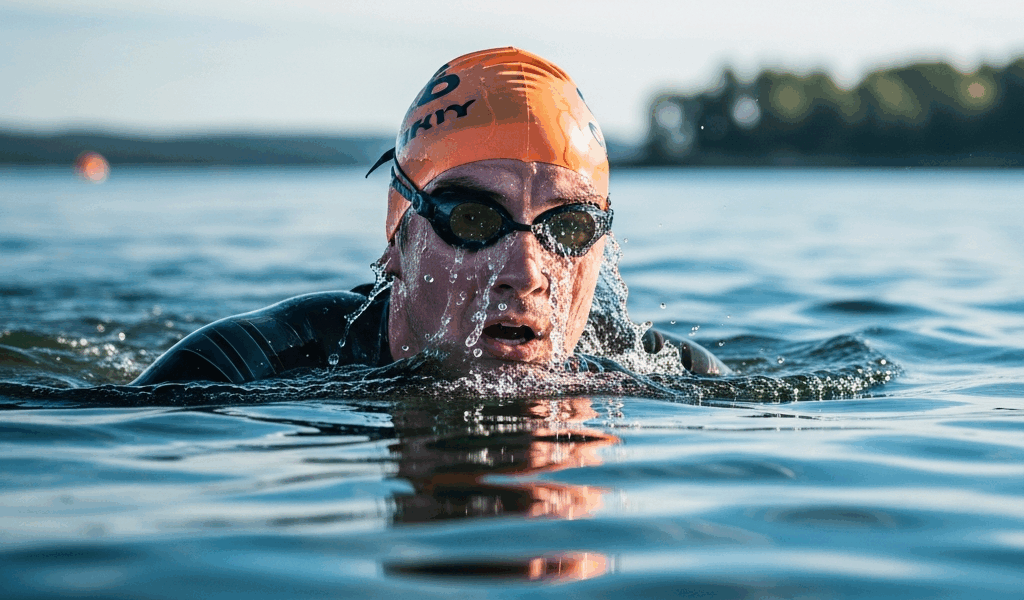
How to Get Over Fear of Open Water Swimming — A Triathlete’s Guide
Open water swimming has gotten complicated with all the panic and dread flying around the triathlon community. I know because I spent two years doing everything imaginable to dodge dealing with mine. Sprint triathlons only — because the swim was mercifully short. Back of every wave start, every single race. Once, at a local Olympic-distance event on a gray Vermont morning, I stood waist-deep in that lake for six full minutes while the race director floated on a paddleboard nearby, watching me with this patient, slightly pained expression. I eventually went. It was awful. But after enough terrible swims and one unexpectedly decent one, something finally shifted.
This is not a technique guide. There are a thousand of those already — and if you’re here, technique isn’t your problem. Your problem is that the second the water goes dark, the bottom disappears, and someone’s heel connects with your face, your brain checks out entirely. That’s what we’re actually fixing today.
You Are Not Alone — Why Open Water Scares Even Fast Pool Swimmers
The fear is rational. Let’s just start there — because most triathlon content blows past this in a single sentence before launching into breathing drills. I’m not doing that.
But what is open water fear, exactly? In essence, it’s your nervous system responding to a genuinely unfamiliar environment before your conscious brain even registers what’s happening. But it’s much more than that. There are no lane lines to grab. The bottom vanishes — sometimes 40 feet down, sometimes tangled in weeds that brush your fingers and send your heart rate straight to 180. Currents exist. Other swimmers exist, and they will swim over you, into you, and occasionally under you in a way that feels oddly like a contact sport. In a pool, your brain always knows exactly where you are. In open water, you surface from a breath and suddenly the buoy that was right there is just… gone.
Aquaphobia research puts somewhere between 46% and 64% of adults in the “uncomfortable in deep water” category. Among triathletes — people who voluntarily chose a sport with a mandatory swim leg — a significant chunk are quietly managing real anxiety about that exact leg. You are not a bad swimmer. You are not weak. You are someone whose threat-detection system is functioning correctly and just needs a bit of recalibration.
The specific triggers tend to cluster around a few things:
- Loss of visibility — can’t see the bottom, can’t see what’s around you
- Absence of reference points — no wall, no lane line, no edge within reach
- Physical contact with other swimmers — unexpected, chaotic, sometimes aggressive
- Temperature drop — cold water triggers an involuntary gasping reflex that hijacks your breathing immediately
- The sheer scale of the environment — lakes and oceans don’t care about you at all, and your brain knows it
Naming these things matters — a lot, actually. When panic hits mid-swim, it arrives as one massive wall of terror. Breaking it into components gives you something specific to respond to instead of just drowning in the feeling itself.
Pool-to-Open-Water Transition Plan
Gradual exposure is the psychological tool here. Not formal clinical exposure therapy, necessarily, but the same underlying principle — you desensitize yourself by getting close to the scary thing repeatedly, in controlled doses, until it loses its grip. Jumping straight into a chaotic race start to “face your fear” is not a plan. That’s how people end up DNS’d at their second triathlon, standing on the shore wondering what went wrong.
Week 1 — Feet on the Bottom
Find a lake, reservoir, or sheltered beach where wading in still means touching the ground. Early mornings work best — fewer people, less chop, quieter water overall. Wear your wetsuit. This actually matters. The wetsuit — I use an Xterra Volt, runs about $190, fits snugly enough to feel secure without crushing your chest — adds buoyancy that genuinely changes the psychological experience of being in open water. You float more. Panicking gets harder when you’re already floating without trying.
Your only job in week one is to get in, walk out until the water reaches your chest, and float on your back for two minutes. That’s the whole assignment. No swimming. Just float, breathe, stare at whatever sky is up there. Do this three times across the week — Tuesday, Thursday, Saturday works fine.
Week 2 — Deeper Water with a Buddy
Bring someone. A training partner, a coach, a spouse who doesn’t mind standing in a cold lake before 7 a.m. Their presence isn’t a safety net to be embarrassed about — it’s a legitimate anxiety management tool. Having another person there tells your nervous system the environment is survivable. That’s not weakness. That’s just how nervous systems work.
Swim parallel to shore, staying within 20 to 30 meters of the beach. Practice sighting — lifting your head to spot a fixed landmark — every six strokes. Stop when you need to. Tread water, breathe, collect yourself, then go again. The goal by end of week two is ten continuous minutes of swimming. Not speed. Not perfect form. Just duration.
Week 3 — Full Swim, Full Conditions
This is where you add real distance from shore and start simulating something resembling race conditions. Find an open water swim group — most triathlon clubs run them on weekend mornings, often free or around $10 a session. Swim with the group. The presence of other people in the water, counterintuitively, actually helps. You can see that they’re fine. You can see that the lake is not, in fact, consuming them.
Target a 400-meter continuous swim. Sight every six strokes. Rest on a kayaker’s board if you need to — completely fine in training. Learning that you can stop at any point removes the trapped sensation that feeds panic faster than almost anything else.
In-Water Panic Management
Here’s the thing nobody wants to say out loud: you can do all the training perfectly and still panic on race day. The swim start is chaotic in a way that calm lake practice never fully replicates — 200 people hitting the water simultaneously, the horn blasting, someone’s elbow finding your ribs at the ten-meter mark. Panic remains possible. You need a protocol before you need it.
The Roll-to-Back Move
Swim coaches teach this specifically for this situation, and it saves races. The moment panic starts rising — heart rate spiking, breathing going shallow, vision narrowing at the edges — you stop forward swimming, roll to your back, and float. Don’t fight for air while face-down. Just roll. Your wetsuit keeps you up without effort. On your back, breathing is easy. The sky is right there. You are not drowning.
Stay on your back until your breathing slows — usually 20 to 40 seconds. Then roll forward and keep going. You lose time. You do not DNF. That’s a trade worth making every single time.
The Breathing Reset
Before rolling back to prone, try box breathing — inhale four counts, hold four, exhale four, hold four. One cycle. That’s enough. It’s the same technique Navy SEALs use in high-stress situations, and it works just as well for panicking triathletes in wetsuits on a Wednesday morning. Slow exhales activate the parasympathetic nervous system — heart rate drops, thinking clears. Your body does the rest.
Use the Safety Infrastructure
Every triathlon stations kayakers and paddleboarders along the course for exactly this reason. Grabbing one to rest is legal in most USAT-sanctioned races — it adds time because you can’t be assisted forward, but you are not disqualified for resting on one. Knowing this before race day changes everything. The course is not a trap you can’t escape. There are actual humans out there whose entire job is making sure you’re okay.
Have a Mantra
This sounds small. Don’t make my mistake of dismissing it — it is not small. A mantra gives your verbal mind something to do besides narrating the disaster unfolding around you. Mine was “smooth and forward” for a long time. A training partner swears by “just swim to the next buoy.” Pick something short, present-tense, and action-oriented. Repeat it when panic knocks on the door.
Race Day Strategies
Probably should have opened with this section, honestly — because even with solid training behind you, race day has its own particular texture of chaos that catches people completely off guard.
Start at the back or the far outside edge of your wave. Middle and front positions in a mass swim start are for people who want to race the swim leg. You want to finish the swim leg. Starting wide gives you clear water for the first 50 meters — which is precisely when panic is most likely to strike. Clear water means nobody swimming over you. Nobody swimming over you means your nervous system stays somewhere near baseline instead of going haywire.
Sight more frequently than you think you need to. Every four strokes in the early part of the swim. This keeps you oriented — and disorientation is a massive panic trigger that’s entirely preventable. Combat it aggressively and without apology.
Wear a brightly colored swim cap — neon yellow or orange — even if the race hands you a white one. Safety kayakers track swimmers visually from a distance. Being visible is being safe, and knowing that safety personnel can actually spot you is surprisingly calming mid-swim.
Arrive early and get in the water before your wave start, if the race permits a warm-up swim. Ten minutes in beforehand acclimates your body to the temperature and burns off some of the adrenaline that’s been building since 5 a.m. Cold water shock — that involuntary gasp when cold water hits your face — drops dramatically if you’ve already been in for a few minutes. Honestly, this single step has saved more triathlon swims than any breathing drill ever invented.
When to Seek Professional Help
If open water anxiety is stopping you from training at all — if you reach the shore and physically cannot make yourself go in, or if you’re having panic attacks the night before races — that is not a training problem. That is an anxiety problem, and it deserves actual proper treatment.
A sports psychologist who works with endurance athletes can accomplish in eight to twelve sessions what years of “just push through it” apparently cannot. Cognitive behavioral therapy, EMDR for specific traumatic water experiences, systematic desensitization — these are evidence-based tools with real track records. Sessions typically run $150 to $250 depending on location and clinician, and many practices now offer telehealth for the non-water-based portions of treatment.
An open water swim coach is a different resource for a different level of anxiety. While you won’t need years of intensive therapy, you will need a handful of focused sessions with someone who specializes in open water confidence — not just stroke mechanics — if you can get in the water but fall apart once you’re 50 meters from shore. The Triathlon America coach finder and USAT coach directory both let you filter by specialty. Use them.
Seeking either resource is not failure. Frustrated by a genuinely bad experience at a race two years prior, I finally made an appointment with a sports psych about a 20-minute drive from my house — Tuesday afternoons, small office, terrible parking. Two sessions in, I understood more about what was actually happening in my body during a panic episode than I’d figured out in years of white-knuckling through swims. Information is power. Getting help is strategy.
The open water is not the enemy. It just feels like one — and feelings, it turns out, can be changed. Slowly, deliberately, with the right tools and enough patience with yourself. You signed up for triathlon. That already tells me something about who you are. Get in the water.


Stay in the loop
Get the latest triathlete today updates delivered to your inbox.