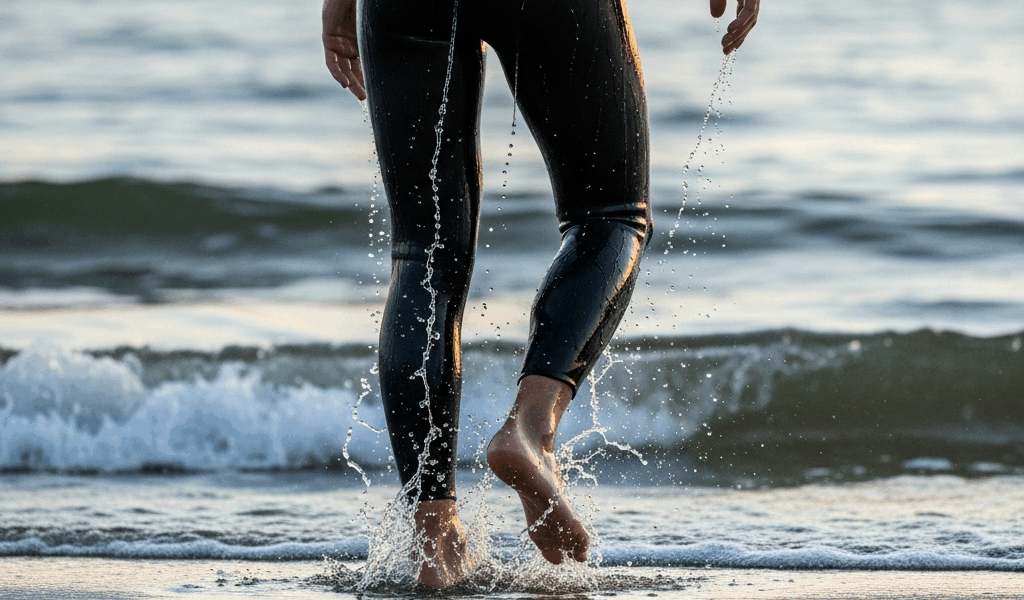
That Wobbly Feeling When You Stand Up
You’ve probably staggered out of the water at a triathlon—legs suddenly feeling like they belong to someone else—and wondered if you were the only one experiencing it. Spoiler: you weren’t. That sluggish swim exit is biomechanically real, and nearly every triathlete encounters it at some point. During my first few races, I hit that disorienting moment where my brain knew I needed to run but my legs felt cemented in place, refusing to cooperate.
Those first ten seconds after leaving the water are brutal. Your vision might blur slightly. Your legs feel impossibly heavy. You lose coordination you didn’t even know you had during the swim. Some athletes describe it as feeling drunk — wobbly, untrustworthy, like your body suddenly forgot how to execute basic movement patterns you’ve trained for months.
Here’s what matters: this isn’t weakness. This isn’t poor conditioning. This is physiology happening in real time, and understanding it changes everything about how you approach the swim-to-bike transition.
Why Blood Pools in Your Legs After the Swim
During the 30-minute swim, your cardiovascular system has been working in a horizontal position. Your heart doesn’t need to fight gravity to push blood down to your legs the same way it does when you’re upright. Water provides hydrostatic pressure — the weight of all that liquid surrounding your body — which compresses your limbs and actually helps push blood back toward your heart. Roughly 400-600 milliliters of blood that was distributed across your entire body suddenly needs to be redistributed when you stand up on the beach.
Probably should have opened with this section, honestly. It’s the mechanical core of the problem.
When you go from horizontal to vertical, gravity immediately pulls blood into the veins and capillaries of your lower legs. Your legs have just finished 45-60 minutes of near-constant activity — in the case of an Olympic-distance triathlon — but that activity was primarily upper-body dominant. Your quads, hamstrings, and calves weren’t driving your forward motion through the water. Your shoulders, lats, and core were. Your leg muscles haven’t been contracting with the intensity needed to keep blood from pooling downward.
Compare this to a runner finishing a 10K. Yes, their legs are fatigued, but their quadriceps have been contracting rhythmically for the entire run, pumping blood upward with every stride. That muscular action is sometimes called the “second heart” for runners — those leg muscles force blood back up against gravity. Swimmers don’t have that advantage. Your calves especially — they’ve been relatively passive passengers for the entire swim, held in a relatively rigid position by fins and streamlining.
This blood pooling causes immediate lightheadedness, reduced oxygen availability to your legs, and that mechanical “heaviness” that makes each step feel like you’re pushing through resistance. Add in the fact that you’ve just removed your wetsuit — losing that external compression — and the problem intensifies.
The Oxygen Debt and Central Governor Effect
Your central nervous system is smarter than you think, even when it feels completely incompetent during those first ten seconds of the exit.
After an intense swim, your legs are in an oxygen debt state. Your muscles have accumulated lactate and hydrogen ions. Your neural system has been firing at high frequency to coordinate those complex shoulder movements, and your brain is processing signals about your body’s current energy state. When you stand up, your body’s automatic systems detect that blood is pooling, that oxygen availability is compromised, and that your legs aren’t immediately ready to bear full load and produce power.
The central governor — a theory popularized by researcher Tim Noakes — suggests that your brain automatically throttles power output as a safety mechanism. It’s not that your legs can’t move. It’s that your nervous system is preventing full power production until oxygen availability stabilizes. The heavy, sluggish feeling is your brain saying: “I need to keep you upright and conscious more than I need to maximize leg power right now.”
This gets compounded by lactate clearance demands. Your swimming muscles still need oxygen for recovery. Your cardiovascular system is trying to redistribute blood volume. Your legs are competing for resources they didn’t use during the swim. The whole system takes 30-60 seconds to rebalance, but those first ten seconds are the roughest.
Four Drills to Fix Your Swim Exit
1. Exit-Transition Breathing Pattern
The moment your feet touch bottom — or your hands touch the beach — begin exhaling and taking controlled breaths. Don’t hold your breath while exiting. It reduces oxygen availability to working muscles. Inhale for two steps, exhale for one. This rhythm signals your parasympathetic nervous system to stop treating the exit as an emergency and helps normalize blood pressure.
2. On-Land Leg Activation Drill
After exiting the water in practice, spend 10 seconds doing rapid-fire leg movements: high knees, butt kicks, or aggressive calf raises. Do this immediately — not 20 seconds later when you reach your transition zone. These movements force your calf muscles to contract hard, pumping blood upward against gravity. You’re manually doing the work your legs didn’t do during the swim. Practice this for 30 seconds total, three times weekly.
3. Pool-to-Pavement Rehearsal
Exit your pool at race pace, remove your goggles, and immediately do a 20-meter walk-to-run transition. Feel where the heaviness hits hardest. Is it when you accelerate? When you change direction? During this dry-run transition, you’ll identify your specific weakness. Run this sequence during one warm-up session per week — it takes four minutes and trains your neuromuscular system to expect the sensation.
4. Race-Pace Exit Simulation
Once monthly, swim 80% of your race distance at race intensity, exit immediately, and begin a 90-second run at race pace. Don’t taper the swim. Don’t do an easy exit. This teaches your body to tolerate and adapt to the exact conditions you’ll face on race day. It’s uncomfortable. That’s the point. Your nervous system learns that this sensation is survivable and that power output normalizes quickly.
What to Practice This Week
Pick one of these and execute it today:
- The 60-Second Protocol. Swim 500 meters at steady intensity. Exit. Perform 20 high knees, 20 butt kicks, and 20 explosive calf raises. Rest 90 seconds. Repeat three times. This is your core drill for addressing muscle activation. Do it once this week.
- The Breathing Anchor. Your next pool session, practice your exit breathing pattern during the final 100 meters of swimming. Transition out, maintain the two-in-one-out rhythm for the first 30 seconds on deck. This costs nothing and immediately improves oxygen delivery to your exit mechanics.
- The Pavement Test. If you swim at a pool, jog to nearby pavement after your next session. Exit the water, walk 10 meters, then run 50 meters at race pace. Notice where your legs feel heaviest. That’s your target area for the race-pace simulation drill above.
The sluggish swim exit isn’t a secret weakness you have to accept. It’s a predictable physiological response with specific mechanical solutions. Your body isn’t failing — it’s recalibrating. Acknowledge that recalibration period exists, and train it out of your system before race day.



Stay in the loop
Get the latest triathlete today updates delivered to your inbox.