Why T1 Falls Apart When It Counts
Triathlon transitions have gotten complicated with all the conflicting advice flying around. As someone who spent two years finishing races with embarrassingly slow T1 splits, I learned everything there is to know about why the swim-to-bike transition breaks down. Today, I will share it all with you.
Race day is nothing like your garage practice sessions. Your heart is hammering at 170 BPM. Water streams into your eyes. The wetsuit clings to your legs like it’s been welded there — at least if you bought a $200 Xterra that fits slightly too snug in the calves. You can’t find your bike rack because everything looks wrong when you’re gasping for air. The helmet buckle suddenly becomes impossible with shaky hands.
Most T1 advice online stops at “practice your transition.” That’s not a diagnosis. That’s a platitude. What you actually need is to understand why yours specifically falls apart — which is a very different question.
Probably should have opened with this section, honestly. The four bottlenecks that destroy T1 time are wetsuit removal, disorientation from the swim exit, fumbling gear under pressure, and mental confusion about the sequence. Most athletes have at least two of these stacked together. Identifying which one is yours cuts your fix time in half.
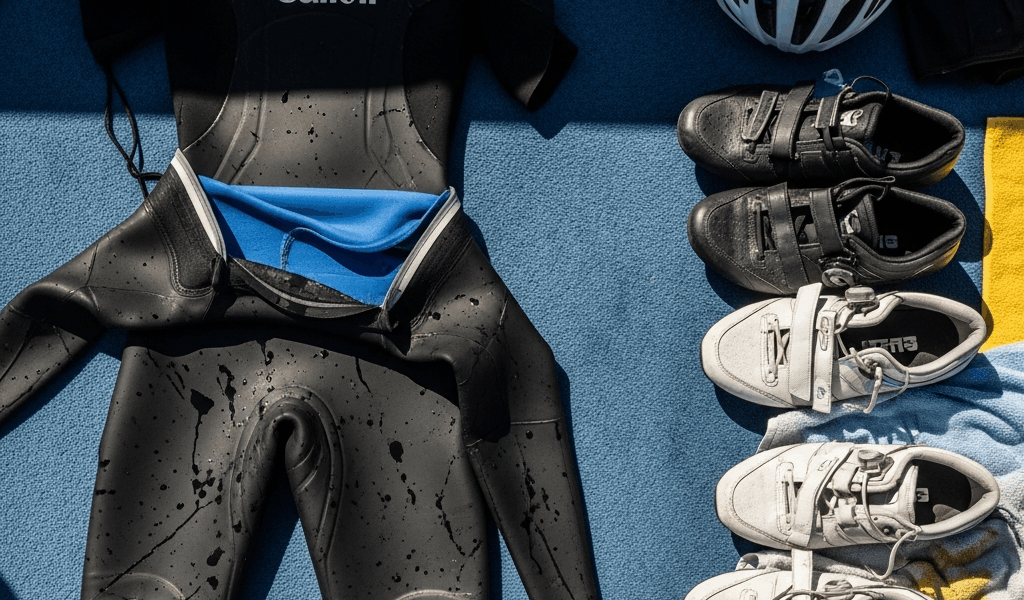
Wetsuit Coming Off Slow at the Ankles
The single biggest time killer in T1 isn’t the helmet buckle. It’s the wetsuit pooling around your ankles while you’re standing in transition, one leg in the air, watching your race drift away.
But what is the correct strip technique? In essence, it’s a controlled peel using momentum and leverage rather than brute force. But it’s much more than that — it’s a sequence you have to practice until it becomes automatic under stress.
Here’s how it actually works: as you’re running up from the water, pull the wetsuit down to your hips while still moving. Don’t stop running. The momentum helps more than people realize. Once it’s at hip level, step on the back panel of the suit — hard — with your opposite foot. That creates traction. Then pull your leg straight out. The suit peels off because you’ve built a lever with your bodyweight. Do the other side. Total time: somewhere between 20 and 35 seconds when done right.
Don’t make my mistake. I spent three full minutes wrestling mine off at my first sprint triathlon in Tempe because I kept looking down, which completely kills your rhythm. Eyes up. Look where your bike is.
The suit gets stuck at the ankles for a second reason: fit. A wetsuit too snug around the calves won’t peel fast — simple as that. When buying, check that you can slip two fingers between the neoprene and your skin at the ankle. Huub and Blueseventy size differently, so don’t assume your usual medium applies. I’m apparently a large in Blueseventy and a medium-large in Huub, and that half-size difference works for me while the wrong fit never does in a race.
Body Glide on your ankles before the race changes things too. Apply it directly to skin, not over sunscreen, about 10 minutes before you pull the wetsuit on. The slip is noticeable — genuinely noticeable, not placebo.
Losing Your Rack Spot in the Chaos
You exit the swim disoriented. The transition area looks like a parking lot when you’re oxygen-deprived. You run past your bike. You turn around. You run past it again. That’s 40 seconds gone just finding the spot you racked two hours earlier.
This is a pre-race problem disguised as a race-day problem.
When you rack your bike, count how many racks from the end of the row. Not landmarks — numbers. “My bike is the fourth rack from the north entrance.” Say it out loud five times while you’re standing there. That’s what sticks.
Better yet, use a visual anchor. Tie a bright towel — hot pink, neon yellow, something ridiculous — on the rack frame right near your bike. From 20 meters away, even through goggle fog, you’ll lock onto it. That’s what makes a garish $4 hand towel endearing to us triathletes — it’s one of the only things in this sport that’s cheap and effective simultaneously.
Walk the run-in path during racking. Stand at the swim exit. Look at your rack. Walk the 30 meters slowly, noting every visual cue. This takes maybe two minutes. When you’re actually in the water, your brain will have filed that path and you’ll navigate on instinct even when you’re confused and exhausted.
Fumbling Helmet and Shoes Under Pressure
Your helmet sits on top of your shoes. Standard setup. But the buckle is clipped shut. You’re wet. Your hands are shaking from 800 meters of open water. It takes 15 seconds to unclip something that should take three.
Fix this the night before. Leave your helmet buckle open on top of your shoes. When you reach your rack, pick up the helmet and click it closed in one motion. Two seconds. Fumbling with a pre-clipped buckle in transition costs you 10 to 12 — every time, without exception.
The helmet goes on before the bike leaves the rack. That’s a UCI rule at most sanctioned races. A marshal will stop you. You don’t want a 10-second penalty because you were trying to save three seconds by buckling while moving — been there, watched it happen to the guy on my left in Columbus last June.
Shoes are a different call depending on race distance. For sprint triathlons, most athletes do better putting shoes on in transition — the run is short enough that the time cost is worth the mental simplicity. For Olympic distance and longer, racking shoes on the pedals or frame saves meaningful time in T2. Test both methods in actual practice. Beginners usually do better with shoes in transition. Less to think about when you’re already overwhelmed.
How to Practice T1 So It Actually Sticks
While you won’t need a full replica transition area, you will need a handful of specific conditions — mainly elevated heart rate, wet hands, and mental fatigue. Those three factors are what make race-day T1 feel nothing like your garage dry runs.
So, without further ado, let’s dive in.
First, you should practice immediately after hard swim sets — at least if you actually want to simulate race conditions. Get out of the pool, run to the parking lot, lay your gear on a towel the way you’d rack it at a race. Strip the wetsuit. Helmet on. Clip the shoes. Time it. Do this three times in 10 minutes with just enough rest between sets to reset your gear. After two weeks, T1 stops feeling chaotic. Your hands know the sequence before your brain catches up.
A local open-water practice triathlon might be the best option, as race-day preparation requires the real thing. That is because you cannot manufacture actual transition-area disorientation in a parking lot — the noise, the bodies, the adrenaline, the unfamiliar sightlines. A $45 sprint race entry as a practice run is the best training investment most triathletes never make.
Realistic numbers: a well-practiced T1 for a sprint triathlon should land under two minutes from swim exit to bike departure. That’s around 1:45 if everything goes cleanly. Olympic distance athletes should target three minutes or just under. If you’re hitting those numbers in practice, you’ll beat them on race day — race-day adrenaline genuinely makes you faster, not slower, once you’ve removed the panic from the equation. This new approach to stress-based practice has taken off over several years and eventually evolved into the structured T1 protocol coaches and competitive age-groupers know and rely on today.

Stay in the loop
Get the latest triathlete today updates delivered to your inbox.