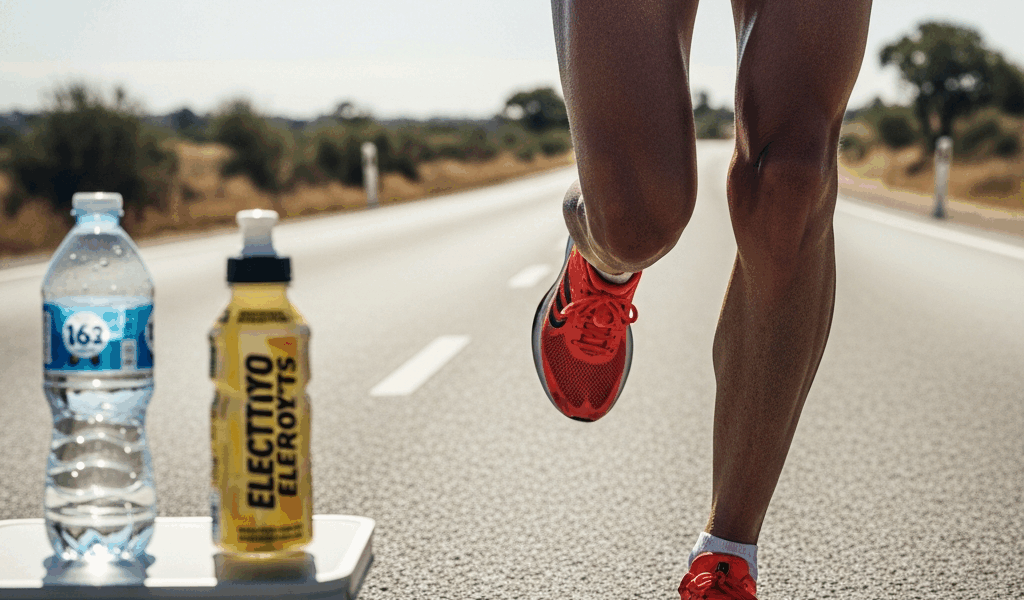
Why Race Day Cramping Is a Different Problem
Triathlon cramping has gotten complicated with all the conflicting advice flying around.
But what is race-day cramping, really? In essence, it’s your neuromuscular system failing under cumulative load. But it’s much more than that — it’s a completely different physiological problem than anything your Tuesday night runs are preparing you for.
Here’s the thing nobody wants to hear. When you run in training, your legs are fresh. Your nervous system hasn’t already spent 45 minutes clawing through open water and another 90 minutes grinding through 90km on the bike. Glycogen stores are topped off. Electrolyte balance is intact. The muscles aren’t pre-fatigued before they even hit the pavement. Race day strips all of that away.
Cramping isn’t primarily a dehydration problem. That’s the old narrative — and it’s stuck around because it’s easy to understand and even easier to sell salt tablets around. The research points somewhere more specific: neuromuscular fatigue. Motor units firing involuntarily under load when the system is already exhausted. The swim hammers your shoulders and stabilizers. The bike destroys your quads and glutes. By kilometer one of the run, those same muscle groups are already sensitized, and then you ask them to do something mechanically different. The motor control system misfires. A muscle contracts and simply won’t let go.
Your Wednesday evening 8-miler starts from a rested baseline. Race day doesn’t. That gap is the whole problem.
The Bike-to-Run Transition Is Usually the Trigger
The last 15 minutes of the bike are often where race-day cramping is actually decided. Most athletes don’t realize this until it’s too late.
Frustrated by a mediocre split at a half-ironman in 2019, I spent the first loop riding smart — controlled watts around 185-190, steady cadence, heart rate hovering at zone 3. Then, with five kilometers left, I spotted a training partner maybe 200 meters ahead of me. My ego did the rest. I dropped into the big chainring and started pushing.
Those final 10 minutes felt genuinely great. I caught him. Passed him. Hit T2 feeling like the race was mine. Then the run started. First kilometer felt fine. Halfway through the second, my left calf locked up like a vice. I had two miles of race left and I was managing cramps instead of managing pace. That’s not coincidence. That’s physiology doing exactly what physiology does.
The quads and glutes that drive your bike are also essential to running — same tissues, different demands. Hammer them through an effort spike in the final bike segment and you’re depleting whatever glycogen remains in the exact muscles that need to fire fresh on the run. Lactate and fatigue metabolites accumulate right where you can least afford them.
That’s what makes the bike-to-run transition so unforgiving to us triathletes. The mechanical shift is abrupt. One plane of movement becomes something completely different, and muscles that are already cooked can’t adapt quickly enough. They cramp.
So, without further ado, here’s what actually works instead: hold the last 10-15 minutes of your bike at RPE 5-6 out of 10. Cadence around 90-95 RPM — not the frantic high-cadence sprint some people chase heading into T2. Save the ego for the run. That’s where you actually make time back, and you cannot make time on a run dominated by cramp management.
What Your Hydration Timing Actually Looks Like vs. What It Should
Probably should have opened with this section, honestly. Because this is where most triathletes quietly fall apart.
Most athletes front-load fluids on the bike. Makes sense — you’ve got a bottle cage, the mechanics are stable, drinking is easy. So you hammer fluids for 90 minutes and feel virtuous about it. Then the run starts. You’re bouncing. Breathing hard. Aid stations appear and disappear fast. You’re supposed to grab a cup, drink it, grab another one two kilometers down the road. Most people immediately fall behind because running and drinking are genuinely incompatible skills for the first few attempts.
You cross the finish line somewhat dehydrated relative to where you were at the bike-run transition. Dehydration alone doesn’t cause cramping — that’s been overstated for decades — but combined with neuromuscular fatigue and electrolyte loss, it becomes the final stressor that tips you over the edge.
The real issue is timing and consistency. A typical triathlete sweat rate runs 0.8 to 1.5 liters per hour. That sweat carries sodium — roughly 300-600mg per liter. Over a four-hour race, that’s serious electrolyte debt accumulating quietly the entire time.
On the bike, a 500mL bottle of something like Precision Hydration 1000 or a Maurten drink mix with 300mg sodium covers a 30-minute segment reasonably well. Manageable. On the run, you need to hit aid stations every 15 minutes on schedule — not when you feel thirsty, but on schedule. Thirst is a late signal. By the time you feel it, you’re already behind. Most aid station cups hold 150-200mL. One cup every 15 minutes equals four cups per hour. Pair that with one Nuun tablet or a Liquid IV packet if you can carry one, adding another 300-500mg sodium per serving. That’s a realistic electrolyte strategy, not a wishful one.
Don’t make my mistake. I skipped the kilometer 8 aid station at a 70.3 in 2021 because I “felt fine.” I cramped at kilometer 10. The math on that decision was not in my favor.
How to Adjust Your Run Pacing to Avoid the Cramp Window
The first 2km of the run is your highest-risk window. Full stop. This is where most athletes feel their first cramp — calf complex or hamstrings, almost always, because they’re taking on a completely different mechanical role after 90-plus minutes of cycling and they’re already fatigued before they start.
Slow down. I mean noticeably slow — not a token 5-second-per-kilometer concession. Aim for 70-75% of your intended run effort for the first kilometer. RPE should feel like a warm-up, somewhere around 5-6 out of 10. It will feel embarrassingly easy. Good.
I’m apparently a chronic pace-pusher out of T2 and a deliberate slow start works for me while surging never does. The math is obvious once you’ve done it wrong a few times. A controlled first kilometer costs you maybe 90 seconds on a 10K run. An unmanaged cramp costs you five minutes minimum, often more. One of those outcomes is recoverable.
No GPS watch? Use this instead: you should be able to speak in short phrases without gasping. Not comfortable conversation — just short phrases. Three to five words. That’s the pace for kilometer one.
Race-Day Fixes If You Feel a Cramp Starting
Prevention is the goal. It doesn’t always work. Here’s what to do when you feel that first warning tightness in the calf or hamstring — that pre-cramp sensation that gives you maybe 30 seconds to intervene.
Drop your cadence immediately. From roughly 180 steps per minute down to 160. This reduces the contractile force each muscle fiber must generate per stride. It feels strange and slow. It works. Your pace drops slightly, but you stay moving forward — which beats the alternative.
Grab water and electrolytes at the next aid station. Sip deliberately. Don’t chug — your GI system is already under stress from two hours of racing and it will let you know about it.
While walking, do this: move forward 20 meters, then backward 10 meters. Add 15 seconds of high knees. This sounds counterintuitive — dynamic movement while cramping — but it breaks the cramp cycle more effectively than stopping cold and hammering a static stretch. Static stretching into a cramping muscle frequently makes it worse. You’re fighting the contraction directly, and the contraction usually wins.
Over the longer term, add one brick session every two weeks: 60 minutes of steady cycling followed immediately by a 20-minute run at intended race pace. This new stimulus takes hold several months out from your A-race and eventually evolves into the neuromuscular adaptation that experienced triathletes know and rely on. It trains your body for the exact transition stress of race day — because nothing else really does.

Stay in the loop
Get the latest triathlete today updates delivered to your inbox.