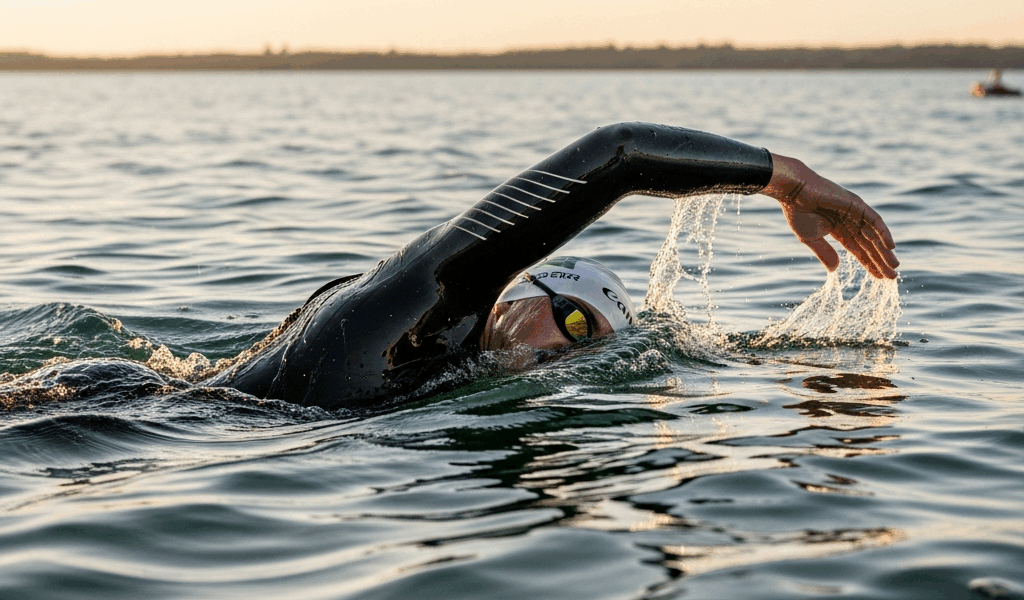
Why Open Water Wrecks Shoulders Differently Than the Pool
Open water shoulder pain has gotten complicated with all the generic “swim more, hurt less” advice flying around.
The pool is forgiving in ways you stop noticing until they’re gone. Calm water. A wall exactly where you expect it. Breathing on your favorite side every lap without a second thought. Open water gives you none of that — and your shoulders are the first to know it.
Three mechanical demands of open water create shoulder pain that pool swimmers almost never encounter. Sighting — lifting your head forward to navigate — shoves your anterior shoulder into a position it was never designed to hold under load. Bilateral breathing collapses the moment chop hits; most triathletes revert to single-side breathing without realizing it, loading one shoulder and upper back asymmetrically for the entire swim. And a wetsuit, especially one slightly snug across the chest, cuts your shoulder rotation by 10–15 degrees — forcing your arms to compensate in ways your rotator cuff absolutely hates. That’s what makes open water so uniquely punishing to shoulders. So, without further ado, let’s dive in.
The diagnostic work starts here. Where does it hurt? When during the swim? Those two questions tell you almost everything.
The Most Common Causes and How to Spot Yours
Poor High-Elbow Catch and Impingement
But what is a dropped-elbow catch? In essence, it’s initiating your pull with your hand instead of your elbow — which lets the elbow sink below the wrist. But it’s much more than that. In the pool it mostly costs you speed. In open water with a wetsuit constricting your shoulder girdle, it becomes an impingement waiting to happen.
A standard 3mm neoprene suit — something like the Rip Curl Dawn Patrol or the Xterra Volt — compresses the shoulder just enough that a dropped elbow tips from “inefficient” into “painful” fast. The pain shows up as sharp and localized, right at the front of the joint, during the pull phase itself. Not after. During.
Self-check: Sharp pain, mid-pull, anterior shoulder. You probably have this one. Don’t make my mistake of icing it and hoping it sorts itself out between swims.
Over-Sighting and Anterior Shoulder Strain
Sighting every 4–6 strokes is the rookie mistake I made for an embarrassingly long time — until my coach told me, bluntly, that I was essentially performing a partial shoulder dislocation drill every few strokes. Lifting your head that often forces your entire shoulder girdle forward into extreme protraction just to keep your hips from sinking.
This pain feels dull and diffuse. Front and side of the shoulder. It builds toward the second half of the swim rather than hitting immediately. More fatigue than acute pain, which is exactly why people ignore it and call it “normal.”
Self-check: Sighting every few strokes? Shoulder fatigue by the halfway point? This is yours.
Wetsuit Restriction and Compensatory Overload
A wetsuit that’s too tight across the upper back — even slightly — kills both internal and external shoulder rotation simultaneously. Your lats and pulling muscles compensate by working harder than they should. After 20–30 minutes, your rotator cuff is cooked.
The pain sits deep in the back of the shoulder and upper back. It peaks on day two or three, not day one — which is the detail most people miss when trying to connect cause and effect.
Self-check: Can you easily slide your hand between your shoulder blades while wearing the suit? If getting your forearm there requires actual effort, the suit is too small. I’m apparently a “true medium” in street clothes and a large in wetsuits — Zone3 fits me well while Xterra in the same size never does. Most triathletes wear one size too small because they assume tight means warmer. It doesn’t. It just means pain.
Dropped Elbow on the Pull
Open water — the chop, the turbulence, slightly degraded spatial awareness — causes even experienced swimmers to drop their elbow instinctively. It feels like stability. It isn’t. A dropped elbow during pull-through loads the anterior shoulder in a vulnerable position, and a wetsuit that’s already limiting your range of motion makes it considerably worse.
Pain is sharp, pull-through phase, almost always one-sided. That asymmetry is the giveaway.
Quick Fixes You Can Apply Before Your Next Swim
Wetsuit Fit Check
Probably should have opened with this section, honestly. Wetsuit fit is the single most controllable variable, and fixing it alone solves the shoulder problem for a surprising number of triathletes — no stroke changes required.
Fully suited and in the water, you should be able to rotate your shoulders freely. Have someone watch you do relaxed arm circles — easy, unhurried circles. If your shoulders are hitching or the suit is bunching up around your neck, it’s too small. Shoulder seams should sit right at the shoulder joint itself, not in front of it.
For reference: most triathletes actually need to go one full size up from their typical shirt size. Xterra runs noticeably smaller than their sizing chart suggests. Zone3 runs generous. Try before you buy when you can — it’s worth the trip to a proper triathlon shop rather than ordering online and guessing.
Sighting Frequency Adjustment
Sight every 8–10 strokes instead of every 4–6. That adjustment alone cuts anterior shoulder strain by roughly half. It feels disorienting the first time you try it. Two swims later it feels normal. Pick one buoy, look at it for exactly one stroke cycle, head back down immediately. That’s the whole technique.
The Fingertip Drag Drill
No equipment needed. Swim freestyle normally — but drag your fingertips along the water surface throughout the recovery phase. A dropped elbow makes this physically impossible, so the drill self-corrects without you having to think about it. Do 4×100m with 30 seconds rest between reps. Three sessions rewires the motor pattern reliably. I’ve seen this fix a shoulder issue that two weeks of stretching hadn’t touched.
When to Be Worried and When to Push Through
Soreness that clears within 48 hours is normal training fatigue. Pain lasting past 72 hours is not. Pain that wakes you at night — stop. Pain at rest — stop. Any numbness or tingling down the arm — stop immediately and see a physiotherapist. These are signs of actual structural irritation: impingement, bursitis, minor rotator cuff strain. Not overuse. Different category entirely.
Sharp, shooting pain during the pull is a stop signal. Dull, achy fatigue that loosens up with light movement and resolves by the next morning? That’s pushable. Most experienced triathletes already know which one they’re feeling — trust that instinct.
Long-Term Habits That Keep Shoulder Pain From Coming Back
External Rotator Strengthening
Face pulls and banded external rotations might be the best option here, as open water swimming requires serious rotator cuff resilience. That is because the infraspinatus and teres minor — the external rotators — are the primary stabilizers against the protraction forces open water creates, and almost nobody trains them directly. A light resistance band, 2–3 sets of 12 reps, two or three times weekly. That’s the entire investment.
Shoulder Mobility Warm-Up Before Swims
Ten minutes — arm circles, cross-body shoulder stretches, band pull-aparts — in the 15 minutes before you enter the water. It prepares the shoulder for the restricted range of motion the wetsuit is about to impose on it. Tedious? Yes. Does it prevent weeks of shoulder pain? Also yes. The math isn’t complicated.
Gradual Volume Build
Frustrated by slow fitness gains, most triathletes jump straight from pool-only training into 2 km open water swims using whatever schedule their training plan printed out. That was 2019 for me. That was also six weeks of shoulder grief I didn’t need. Build open water volume by 10–15% per week maximum. Two weeks of gradual adaptation prevents six weeks of rehabilitation. The arithmetic strongly favors patience.
Fix these things now — before race season compresses your timeline and turns a manageable problem into a DNS. Shoulder pain is fixable. But only if you address what’s actually causing it, not just where it hurts.



Stay in the loop
Get the latest triathlete today updates delivered to your inbox.