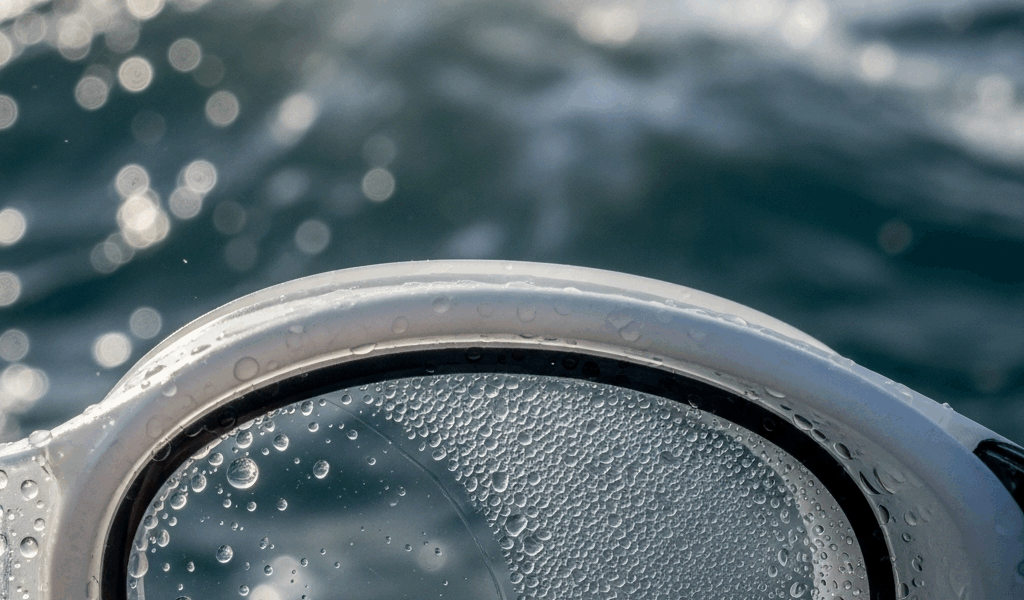
Why Goggles Fog Worse in Races Than in the Pool
Goggle fogging has gotten complicated with all the bad advice flying around. Everyone blames cheap lenses or cheap anti-fog spray. But the real answer has nothing to do with either of those things — at least not primarily.
But what is goggle fogging, really? In essence, it’s condensation forming on the interior lens surface when warm, humid air meets a colder surface. But it’s much more than that — especially on race morning, when your body is doing things it simply doesn’t do during a calm training session.
Here’s the setup. You’re standing in the staging area at 6:47 a.m. You’ve got a 3mm wetsuit trapping every degree of body heat you’re generating. Your heart rate is already at 90, maybe 110 bpm — just from standing there. Pre-race adrenaline is real and it is measurable. Your skin temperature around the goggle seal sits somewhere around 92–95°F. The water you’re about to walk into? Fifty-eight degrees. Maybe colder. That 35-degree gap is the whole problem. The goggle lens bridges those two temperatures. Warm air from your face hits cold polycarbonate from the water side. Tiny droplets form. Your vision goes.
Dunking your goggles in the water five minutes before the start helps. Most people skip it. More on that in a moment.
What makes race-morning fogging so much worse than pool fogging is the adrenaline. Your sympathetic nervous system is activated — blood vessels dilate, skin temperature climbs a little higher than it would during a relaxed training swim, and your breathing is already elevated before you’ve taken a single stroke. You’re exhaling warmer, more humid air into that sealed goggle cavity. Moisture has nowhere to go except the lens.
A tight swim cap or wetsuit hood pressing down on your goggle frame makes everything worse. Probably should have opened with this section, honestly. I’m apparently someone with a narrower-than-average face and my Roka F2s work for me while basically every generic goggle frame never seals properly. I spent two triathlons blaming the lenses. Don’t make my mistake. The hood compresses the frame, the seal weakens, warm air pockets form inside the cavity, and condensation accelerates from there.
The Pre-Race Prep That Actually Prevents Fogging
Anti-fog treatments exist on a spectrum from genuinely excellent to basically useless. Honestly, most of the decent ones work fine. What separates them on race morning is survivability — chaos happens, and some treatments hold up better than others.
- Commercial anti-fog spray — Brands like Optix 55 and TYR’s DefenseSOAP run $8–15 a bottle. Spray both lenses, wait about 30 seconds, and then do not wipe it clean. Do not touch the inside of the lens with your fingers. This is where people fail — they spray it on, second-guess themselves, “just wipe it once,” and strip the entire treatment off. Apply it 10–15 minutes before water entry and then put the goggles down and walk away.
- Baby shampoo — A thin coat of Johnson’s No More Tears or any tear-free formula works nearly as well as commercial spray and costs around $4 for a bottle that’ll last you an entire season. Same rule applies: apply it with a clean cloth, don’t touch it again, set them aside while you finish your gear check.
- Saliva — Effective in a pinch. Saliva contains mucins that reduce surface tension and prevent droplets from forming. Spit into the goggle, spread it around with one finger, let it sit. This is your transition-area backup plan. It won’t hold for a full 1,500-meter swim, but it’ll give you 15–20 minutes of workable clarity.
The step that almost nobody does — and the one that matters most — is temperature equilibration. Five to ten minutes before the swim start, submerge your goggles completely in the open water and leave them there. Just let them sit. The lens temperature climbs to match the water temperature. When you put them on and start swimming, the temperature differential between the lens and the air trapped inside the goggle is dramatically smaller. Fogging drops off sharply.
I learned this at a June triathlon in Michigan. Water temps were 62°F that morning. I’d applied anti-fog spray the night before — carefully, no wiping — but I never dunked the goggles beforehand. By the 400-meter mark, I was swimming blind. The spray had helped somewhat, but the temperature shock was too much for it to overcome. That was 2019. Now I dunk first, apply treatment second, enter the water third. Every single race.
Goggle Fit Is Causing More Fogging Than You Think
A poor seal lets water seep into the goggle cavity. Water mixes with warm air from your face, condensation accelerates, fogging intensifies. You can apply $15 commercial spray with surgical precision — if your goggles are leaking, you’re already losing.
Swim caps and wetsuit hoods are the usual culprits. That latex neck seal or neoprene hood shifts your goggle frame slightly upward or pinches it inward. The frame tilts maybe two or three millimeters. That’s enough. The seal breaks. Water enters.
Here’s a fit-check you can run in transition without removing your wetsuit. Put the goggles on while standing on pavement. Push gently on the frame — it should sit evenly on both sides of your face, bridge not crooked, seal snug but not cutting off circulation to your temples. Now pull your cap and hood on over them. Still sitting level? If the hood pulls them upward or angles them even slightly, adjust the goggle position or hood position before you walk to the water. That’s 45 seconds. It prevents most mid-race fogging incidents. That’s what makes this check endearing to us triathletes who’ve learned it the hard way.
What to Do When Your Goggles Fog During the Race
You’re 800 meters into a 1,500-meter swim. The fog hit at the 400-meter turn buoy and you didn’t catch it in time. Options still exist — none of them are perfect.
The flood-and-drain move: At the next buoy, pull the bottom of the goggle frame slightly away from your face. Let water rush in. This washes the fog off the interior lens surface. Press the frame back, exhale hard through your nose to push the water out. Three to four seconds total. This works well if you catch the fogging early — late-race fogging is harder to clear because fatigue makes your seal looser and your face is more swollen from effort.
The forehead flip-and-skim: Flip the goggles up onto your forehead for two or three strokes while keeping your head down and reading the water with naked eyes. The lens air-dries and clears. Risky — you’re essentially swimming blind for a few seconds — so only attempt this in calm, open water where you’re already confident about course direction.
The hard truth: Sometimes you finish foggy. You sight off landmarks instead of relying on your lenses. You count strokes. You follow the feet in front of you. It happens to experienced triathletes regularly. It’s not a gear failure or a preparation failure every time — sometimes conditions just win.
Which Goggle Lens Tints Fog the Most and Why
Dark mirrored lenses fog faster in cold open water than clear or lightly tinted lenses. That might seem counterintuitive, so here’s what’s actually happening. Dark lenses absorb minimal light energy in early morning or overcast conditions — which describes most triathlon swim starts almost perfectly. So the lens stays cooler longer. The temperature differential between your warm face and the cold lens widens. Condensation forms faster.
Clear lenses and light amber or rose tints — something like a Category 1 tint — maintain a temperature closer to your skin temperature. They absorb more ambient light even on cloudy mornings, which nudges them slightly warmer and narrows that differential. For early-season races or anything below 65°F water, skip the dark mirrored lenses entirely. Grab a clear or light-tint option. You’ll give up some sun glare protection. You’ll gain meaningfully better fog resistance. For most open water racing conditions — overcast skies, 7 a.m. starts, cold water — that’s the right trade.


Stay in the loop
Get the latest triathlete today updates delivered to your inbox.