Why Transitions Feel Fine in Practice and Fall Apart on Race Day
Triathlon transitions have gotten complicated with all the conflicting advice flying around. Everyone’s got a YouTube tutorial. Everyone’s got a system. And yet you’re still standing in T1 with a wetsuit bunched around your knees wondering where your helmet went.
Here’s what nobody says out loud: transition isn’t a checklist you perform. It’s a skill you execute under pressure. Your brain operates completely differently when your lungs are burning, your hands are shaking from adrenaline, and there are 200 people watching you fight with a zipper pull.
Adrenaline does something genuinely weird to fine motor control. You miss buttonholes. You pull your goggles off and spend four seconds looking for them — they’re in your left hand. Crowd noise adds cognitive load your brain wasn’t budgeting for. Suddenly remembering that your helmet goes on before your shoes becomes a genuine challenge, and that practiced 90-second transition quietly becomes a 2-minute disaster.
You didn’t forget how to do it. You just never practiced under the conditions that actually matter.
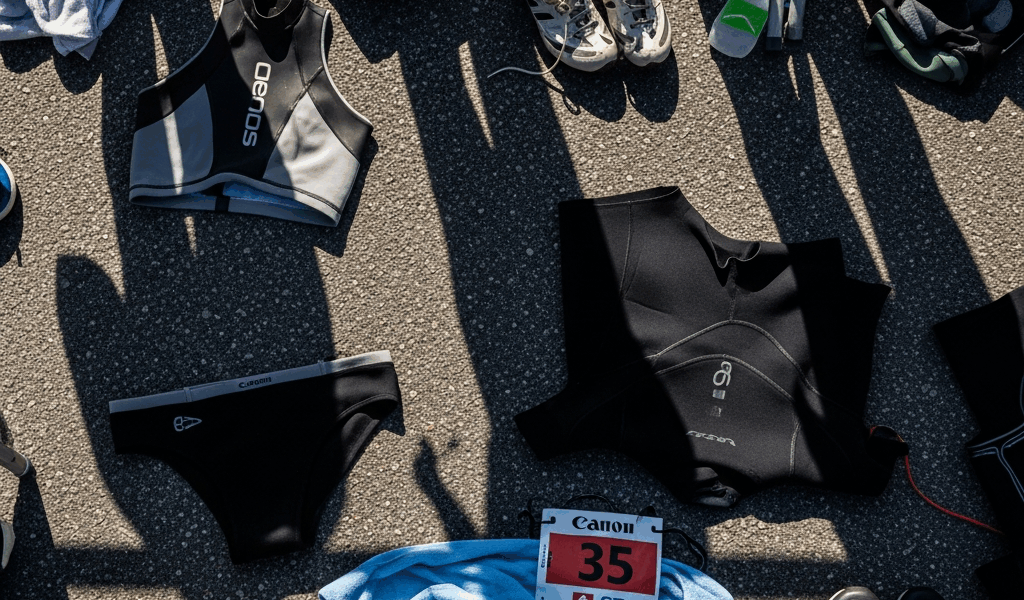
The Wetsuit Exit Is Where Most Athletes Lose the Most Time
Probably should have opened with this section, honestly. Wetsuit removal is the single biggest time sink in T1 — and I’ve watched hundreds of athletes do it wrong in exactly the same way.
The mistake looks like this: exit the water, walk to the rack, then start peeling like the suit is a full-body cast. Grab the shoulders. Pull upward. The neoprene bunches at the elbows. Everything stops. You plant your feet and do this whole performance just to get the thing to your waist.
Wrong sequence. Here’s what fast athletes actually do:
- Unzip while you’re still moving toward your rack — not standing still
- Peel shoulders and arms while jogging, let gravity and momentum do the work
- Sit down only if absolutely necessary, and only for 2 seconds max
- Strip below the waist in one motion without fully stopping
- Step out of the suit while walking toward your gear
Body position matters more than people realize. Standing upright trying to wrench a wetsuit off means fighting gravity and compression at the same time. Moving — even jogging slowly — lets the suit peel easier because your legs are already in motion. A Roka Maverick X or Aquaman Cell suit doesn’t fight you harder when you’re moving. It actually cooperates, because you’re not creating opposing force.
I lost 35 seconds on a wetsuit removal once. Sat down to take it off, couldn’t get my feet out cleanly, sat there like an idiot. 35 seconds. On a course where the winning margin in my age group was 43 seconds. Don’t make my mistake.
The unzip-while-running approach saves 15-20 seconds minimum. Most athletes skip it because it feels less controlled. It’s not less controlled — it just feels unfamiliar for the first five attempts.
Gear Layout Mistakes That Cost You Seconds You Never Get Back
Your rack setup is either helping you or quietly destroying your race. There’s genuinely no middle ground here.
But what is a race-ready layout? In essence, it’s an arrangement your exhausted brain can navigate on autopilot. But it’s much more than that — it’s removing every micro-decision from a moment when your decision-making is already compromised.
The problem: your brain is already maxed out from the swim. Operating on fumes. The last thing it needs is a scavenger hunt. But that’s exactly what happens when your helmet is upside-down, your sunglasses are nested inside it facing backward, and your shoes are pointed the wrong direction.
A race-ready layout works like an assembly line:
- Helmet sits right-side up, visor forward, sunglasses placed directly in front — not stuffed inside
- Shoes sit where your feet naturally land when you reach for them, toes pointing toward your bike
- Race belt and any extras occupy the same spot every single race
- Nothing sits on top of anything else. Ever.
Sounds obvious. It isn’t. I’m apparently someone who once showed up to a race with my Oakley Jawbreakers clipped to the back of my helmet, and that setup never worked for me while every other layout somehow always did. I’ve also watched athletes bag their entire gear setup inside a small transition bag they then had to unpack under fatigue. Baffling.
Every second spent searching is a second your heart rate stays elevated. You’re not resting during that search. You’re panicking while pretending to organize. Your brain flags the misplaced helmet as an anomaly, interprets that anomaly as a minor threat, and suddenly putting on shoes takes three times longer than it did in the driveway.
T2 Is Slower Than T1 for Most Age Groupers — Here Is Why
T2 kills more races than T1. Almost nobody talks about it because most transition content is obsessed with the swim-to-bike handoff and ignores everything after the bike entirely. That’s a mistake.
The mechanics are completely different coming off the bike. Your legs are cooked. Your brain has been executing race strategy for somewhere between 30 and 90 minutes. Cognitive fatigue is real, and it shows up immediately in T2 — usually in ways that feel invisible until you review your split data.
The specific failures in T2 almost always look like this:
- Perfectly racking the bike instead of just hooking it and moving immediately
- Sitting down to put on run shoes — costs 8-10 seconds versus putting them on standing
- Forgetting to pre-tie shoes or use elastic laces, forcing a full kneeling knot-tying session mid-transition
- Stopping to adjust a race belt or grab nutrition instead of just moving forward and sorting it out on course
The bike doesn’t need to be perfectly racked. It needs to be racked and out of your way. A 0.5-second rack is identical to a 3-second rack the moment you cross the finish line. Nobody reviews the aesthetics of your transition setup afterward.
Sitting down to put on run shoes feels stable. It’s also slow — and standing back up when your legs are already wrecked makes everything worse. Standing, balancing against the rack, sliding into pre-tied shoes: about 5 seconds. The full sit-down production: 12-15 seconds. That’s not a rounding error across a race.
Pre-tie your shoes before race morning. Use elastic laces or a speed-lacing system. Hoka makes elastic laces for around $8. I’ve used them for three seasons. That was 2021, and I haven’t gone back to regular laces once.
How to Actually Practice Transitions So Race Day Feels Automatic
So, without further ado, let’s dive in. Not a ten-step program — just the things that actually move the needle.
Drill 1: Wet and tired. Practice your transition after a swim. Not before. Not “I’ll run a few transitions separately tomorrow.” After a swim, when your hands are cold, your goggles are fogged, and your brain is already running on empty. That’s the only condition worth training for.
Drill 2: Time yourself. Every. Single. Attempt. Use your phone. Set a timer. Know your baseline. Most athletes genuinely have no idea whether they’re improving because they’ve never measured anything — while you won’t need a full race setup in your driveway, you will need a handful of your actual race gear and a stopwatch to make this drill worth anything.
Drill 3: Practice the exact sequence three consecutive times. Same order, same layout, same gear placement. Three times back-to-back. Your motor memory needs repetition to encode a movement as automatic — not just repeated, but repeated correctly and consistently until your hands just know what to do next without asking your brain.
That’s what makes the fourth discipline endearing to us triathletes — it’s the one place where a few hours of specific, targeted practice can drop minutes off your race time without any additional fitness. Athletes who get this right don’t think about transitions on race day. Their body just executes. Everyone else is still problem-solving at 85% max heart rate, wondering why the helmet feels different than it did at home.


Stay in the loop
Get the latest triathlete today updates delivered to your inbox.