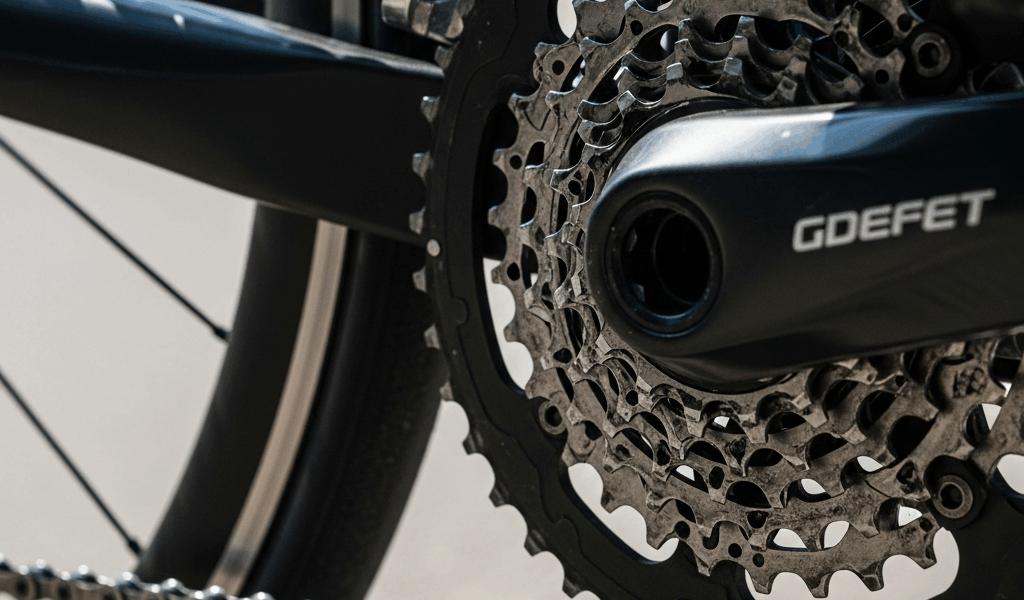
What Chain Slip Actually Is and Why It Happens Under Load
Chain slip during hard efforts—that sudden loss of power transfer when you’re pushing hard into a climb or surging toward the run in a sprint triathlon—is one of the most rage-inducing mechanical failures on race day. I’ve experienced it exactly once during a Half-Ironman when I was hitting the final 2k of the bike course, and let me tell you, it’s both terrifying and humbling.
Here’s what’s actually happening. When you’re generating maximum power — accelerating hard in the big ring, grinding uphill, or standing on the pedals — your chain is under tremendous tension. If something is even slightly misaligned or worn, the chain can slip momentarily off the teeth of either the cassette sprockets or the chainring itself. Unlike a ghost shift, where the derailleur moves between gears but the chain doesn’t, true chain slip means the chain stays in the same gear but loses engagement with the cogs.
The specific conditions that trigger slip are predictable, honestly. It happens most often in the big ring under high cadence and high power. Why? The chainring has fewer teeth than smaller cogs, so each tooth bears more load. Add fatigue—yours and the drivetrain’s—late in a race, and the problem compounds. Triathletes face this particularly hard because we’re demanding everything from the bike leg. You’re fresh coming off the swim, so power output is high. Then late in the ride, during climbs in the final kilometers or that critical push before the dismount, you’re fatigued and still asking the drivetrain to deliver. The bike-to-run transition amplifies any mechanical weakness because you can’t afford to drop power or coast to fix something.
Unlike road cyclists who can ease off and diagnose, triathletes need the drivetrain to be bulletproof. That’s what makes treating slip as a triathlon-specific problem—not just another maintenance task—endearing to anyone who’s actually raced one of these things.
Check Your Derailleur Alignment and Cable Tension First
Before you replace anything, diagnose properly. Most chain slip comes from derailleur misalignment or cable tension issues, not worn parts. I learned this after calling my mechanic in a panic thinking my cassette was destroyed, only to discover a B-screw needed adjustment. Don’t make my mistake.
Start with visual inspection. Stand the bike on a trainer or have someone hold it. Shift to the big ring and look at the derailleur cage from behind the bike. The cage should run parallel to the cassette. Any lateral deviation means the derailleur hanger is bent, likely from a crash or rough handling. If the hanger is bent, you’ll need a derailleur hanger alignment tool or a trip to the shop — this isn’t a home fix.
Next, check cable tension. This is where 80% of slip problems live, honestly. The shifter cable pulls the derailleur. If the cable has stretched — which happens over a race season, especially if you ride hard — the derailleur won’t move fully across the cassette under load. To adjust: shift to the smallest cog. Look at the cable where it enters the derailleur. You should see slight tension but not strain. If the cable looks loose, locate the barrel adjuster on the derailleur, usually a small cylindrical fitting where the cable housing ends. Turn it counterclockwise a quarter-turn. Shift back and forth across the cassette. The derailleur should snap crisply without hesitation.
The B-screw controls the gap between the derailleur cage and the cassette. Too large a gap and the chain can slip on big cogs. Adjust the B-screw by turning it clockwise to bring the cage closer, or counterclockwise to move it away. You want about 2–5mm clearance when the chain is on the largest cog. Use the limit screws, marked H for high gear and L for low, to prevent the derailleur from throwing the chain off the ends of the cassette. These shouldn’t need frequent adjustment, but if you’ve replaced the cassette recently, check that the H-screw stops the chain on the smallest cog without forcing.
Test your fixes by shifting hard under load. Find a moderate hill and stand on the pedals, shifting through the gears as you climb. If slip disappears, you’ve solved it with a $0 adjustment. If not, move to the next step.
Inspect Your Chain Wear and Cassette Compatibility
A stretched or worn chain is the second-most common slip culprit. Chains wear over time and miles, and a worn chain doesn’t sit properly on cassette teeth. This causes slip, especially under load.
The ruler trick is fast and accurate. Lay a ruler against the chain pins. Measure 24 links — each link is 0.5 inches, so you’re measuring 12 inches. A new chain should measure almost exactly 12 inches. If yours measures 12 1/16 inches or more, the chain is stretched and needs replacement. Most mechanics recommend replacing the chain before it reaches 0.5% elongation, but triathletes running multiple wheel sets or training hard through a long season often see their chains reach 1% stretch before they notice slip.
Here’s something many people miss: cassette and chain compatibility matters, especially if you rotate wheel sets or train year-round. If you’ve been running a 12-speed cassette with a 10-speed chain — common if you’ve frankensteined components together — slip is nearly guaranteed under power. Check your derailleur and shifter to confirm what speed your drivetrain is supposed to be. Mixing speeds creates incompatible tooth spacing, and the chain won’t seat properly.
Worn cassettes contribute too. Look at the teeth on your largest cogs. If they’re hooked or severely beveled, the cassette has worn alongside your chain and needs replacement together. You can’t resurrect a wrecked cassette with cable adjustments.
Age of components matters more than you’d think. A derailleur that’s been through three seasons of hard training and racing — especially if you trained through the winter in salt or rain — can develop internal wear that no adjustment fixes. If your derailleur is five years old and you’ve logged 10,000+ miles on it, don’t be surprised if worn jockey wheel bearings contribute to slip. That’s apparently how mine failed.
How to Prevent Slip on Race Day Without Mechanical Knowledge
Probably should have opened with this section, honestly. The best fix is prevention.
Tactical riding prevents most slip. Anticipate your gear changes. On a climb, downshift before you truly need the smaller gear — don’t wait until you’re barely moving and demanding everything. This reduces the load on the chain during the shift. Avoid cross-chaining, small ring with small cog or big ring with big cog, which creates excessive chain angle and tension. Even if you can technically shift into that combination, don’t under hard effort.
Soften pedal pressure during shifts. This is the simplest trick, and it works. Reduce power for one second as you shift, then resume. Doing this removes load from the chain, allowing the derailleur to move freely. On race day, this costs almost nothing in time but eliminates slip risk during climbs.
Pre-race preparation is everything. One week before race day, clean your entire drivetrain with degreaser and a brush. Dried chain lube and dirt gum up the cassette and derailleur. Rinse thoroughly and reapply fresh lube. The day before the race, test every gear combination hard. Stand on the pedals and shift through all cog and ring combinations under tension. If slip happens now, you catch it before it happens at mile 35 of the bike course.
Check your chain lube state. A dry chain loses grip on the cassette. If your chain looks dull and dusty, it’s under-lubricated. Add fresh lube to each link, let it soak for 30 seconds, then wipe excess off. Proper lube makes the difference between smooth power transfer and slip.
When You Need a New Chain, Cassette, or Derailleur
If diagnosis shows wear, here’s the decision tree.
Chain only: Replace if it measures beyond 0.5% elongation and the cassette teeth look normal. You’re looking at roughly $40–80 depending on speed and brand. Timeline: Replace as part of regular maintenance, not emergency-only.
Chain and cassette together: If the chain is worn and cassette teeth show hooking, replace both. A new chain on a worn cassette will skip immediately. Cost is $100–200. This is common for triathletes running multiple wheelsets because load is distributed across fewer components.
Derailleur: Replace only if the hanger is bent, requiring hanger replacement too, or if testing shows worn jockey wheels. Cost is $150–400 depending on groupset. If you’re replacing the derailleur, confirm it matches your groupset speed and pull type — Shimano, SRAM, Campagnolo. Buying the wrong derailleur is an expensive mistake.
Timing: Replace chains and cassettes at the start of hard training blocks, not mid-season. If you’re training for a spring triathlon, replace worn components in January or February. This gives you weeks to test before race day and avoids last-minute panic.
Your drivetrain is doing the hardest work on race day. Give it the attention it deserves.



Stay in the loop
Get the latest triathlete today updates delivered to your inbox.