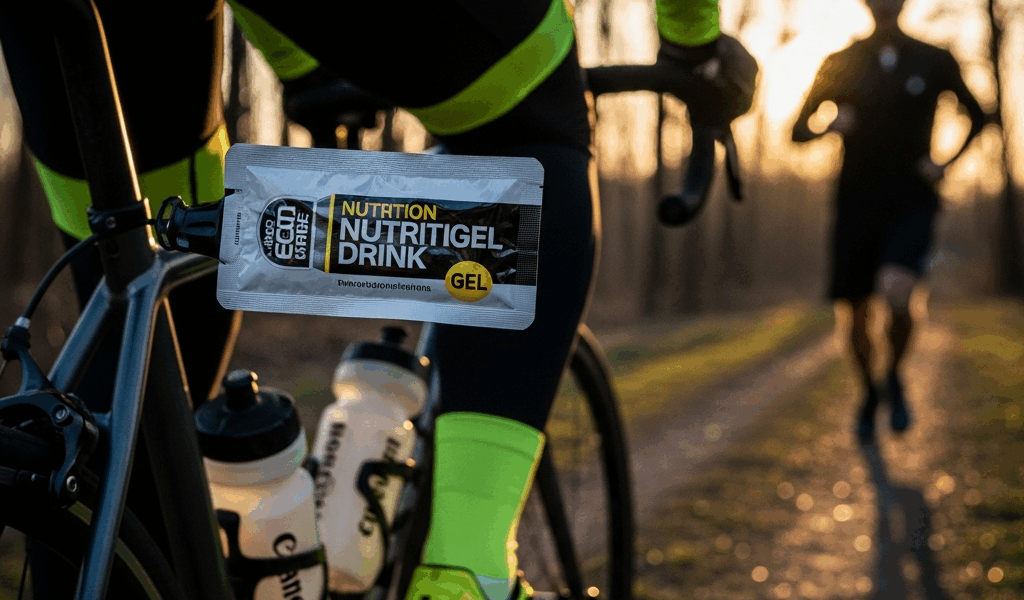
What a Triathlon Run Bonk Actually Feels Like
Triathlon fueling has gotten complicated with all the conflicting advice flying around. But the run bonk — that specific, devastating collapse somewhere between mile 2 and mile 3 — isn’t mysterious. It’s predictable. And it starts long before you ever leave T2.
Here’s the sensation you probably know too well. You roll off the bike feeling okay. Legs are heavy, sure, but manageable. First mile of the run almost feels easy — maybe you catch yourself thinking about a strong finish time. Then it happens.
Your legs turn to concrete. Pace drops 90 seconds per mile with no warning. Brain goes foggy. Everything shifts from “I’ve got this” to “I might have to walk this in.” It’s not fatigue building gradually. It’s a cliff. One moment you’re running; the next, you’re wading through something invisible that nobody else around you seems to feel.
This isn’t regular race tiredness. You know what tired feels like — you’ve done the long training runs. This is a system failure. A sudden shutdown. Your body stops cooperating mid-stride, and your mind goes quiet in that specific, hollow way that means the fuel tank just hit empty.
The frustration is worse because you trained for this distance. Your aerobic base is solid. Your fitness is genuinely there. So what gives? The answer — the real one — is what separates athletes who figure out triathlon from athletes who keep repeating the same race-day disaster year after year.
Why the Bike Sets Up the Run Bonk
The bonk doesn’t start on the run. It starts on the bike.
Most athletes push slightly too hard through the middle and final third of the bike leg. Not dramatically hard — maybe 5 to 10 watts over their sustainable threshold. The equivalent of “feels fine” instead of “feels controlled.” That small margin seems irrelevant in the moment. Over 56 minutes, it isn’t.
Your body runs on glycogen. Think of it as a primary fuel tank with a fixed size. Every watt over your sustainable pace burns through that tank faster than it should. By minute 40 of the bike, that small daily overage has already cost you real, measurable fuel. You don’t feel it yet. You will.
The second problem is more subtle — and honestly, more common. Around 30 to 40 minutes into the bike, most athletes stop eating with any intention. The effort feels manageable. You’re not suffering. Gut feels fine, so you skip the nutrition schedule. You tell yourself you’ve got enough stored fuel to coast to T2.
You don’t.
There’s also a mechanical absorption problem that most athletes never account for. At moderate-to-high effort, blood flow reroutes away from your digestive system toward your working muscles. Your gut deprioritizes food processing when your legs are demanding oxygen. So even if you’re taking in 200 calories every 20 minutes, your body might absorb 120 of those. The other 80 calories sit in your stomach doing nothing useful.
Riding at 85 percent of FTP instead of 78 percent doesn’t feel significant in the moment. Over an hour, it’s the difference between arriving at T2 with a half-empty tank and arriving with nothing left at all.
The Fueling Window You Are Probably Missing
Probably should have opened with this section, honestly. This is where the bonk actually gets coded into your race — before the run even begins.
The final 30 minutes of the bike and the first mile of the run are the critical window. Most athletes either stop eating entirely in the last half-hour of the bike, or they eat one last thing around minute 50 and assume the run takes care of itself. Both approaches fail. Reliably.
Here’s what actually happens: You exit T2 feeling okay. Glycogen is lower than you realize, but you’re still running on the tail end of whatever you absorbed on the bike plus the adrenaline hit of the transition. First mile feels almost normal. Pace feels right. Effort feels right.
Around mile 2, your liver tries to release stored glucose to keep blood sugar stable. But those glycogen stores were already partially depleted on the bike. The tank empties faster than it should. Blood glucose drops. Suddenly your legs stop responding and your brain stops firing cleanly — and you’re standing on the course wondering what just happened to you.
The fix is timing, not magic. You need 30 to 40 grams of carbohydrate in the 20 to 30 minutes before T2, and another 15 to 20 grams within the first mile of the run. Not 60 grams dumped in at minute 55 because you suddenly remembered you forgot to eat. Distributed calories, taken when your gut can actually process them at reduced intensity.
A Clif Bar — 250 calories, 42 grams of carbs — eaten at minute 40 of the bike, finished and partially absorbed before T2, plus a handheld flask of sports drink around 200 calories and 50 grams of simple carbs sipped between T2 and mile 1. Those specifics matter more than the brand. The timing matters more than the food type, honestly.
How to Diagnose Your Specific Bonk Pattern
Not all bonks are identical. Your failure pattern tells you exactly what to fix — at least if you’re paying attention during the race instead of just suffering through it.
When does it hit? A bonk arriving at mile 2 to 3 points to a late-bike fueling problem. One showing up at mile 4 or 5 is more likely a pacing issue — you started the run too aggressively and burned through remaining fuel in the opening miles.
What did you eat in the last 45 minutes of the bike? Write this down after your next two races. If the answer is “nothing” or “one gel somewhere around mile 20,” you found your problem. If you ate something and bonked anyway, the issue is probably absorption — your bike effort was too high for your gut to process food efficiently.
What was your bike effort? If you don’t have power data, estimate based on perceived exertion relative to training. Did you hold back or did you push? Most athletes who bonk on the run pushed on the bike. Not aggressively. Just 10 percent harder than the plan called for.
What’s your T2 strategy? Some athletes spend 90 seconds there. Some sprint through in 45. If you’re moving fast through transition, you’re not eating or drinking. The urgency is costing you the fuel window.
Race-Day Fixes You Can Test Right Now
Here are concrete changes — specific ones, not vague advice.
First, target 82 to 85 percent of FTP on the bike for an Olympic-distance race. Not 88, not 90. That five-watt difference accumulates into 45 to 60 fewer calories burned over the bike leg, with roughly 30 grams more glycogen preserved heading into T2. Small number, big consequence.
Second, take 30 to 40 grams of carbohydrate somewhere between minute 40 and minute 55 of the bike. A single-serving Mott’s applesauce pouch — 90 calories, 24 grams of carbs — plus half a Clif Bar at 125 calories and 21 grams works well. So does a rice cake with honey if your stomach tolerates real food mid-effort.
Third, have a dedicated bottle or handheld flask in T2 specifically for the first mile of the run. Not the same bottle from the bike. A fresh one — 200 calories, simple carbs, maybe some sodium. Drink half of it between T2 and mile marker 1. I’m apparently a Maurten 160 person and it works for me while straight Gatorade never settles right mid-run. Don’t make my mistake — figure out your gut before race day, not during it.
Fourth, run mile 1 at a pace that genuinely feels too easy. This is where most athletes lose the mental battle. Your legs want to move after the bike. The adrenaline is real. Run easy anyway. A 90-second buffer in mile 1 is fuel preservation — not weakness, not wasted time.
The bonk isn’t a fitness problem. It’s a logistics problem. And logistics problems have solutions.

Stay in the loop
Get the latest triathlete today updates delivered to your inbox.